
A launch for two cooperating spacecraft
Proba-3 lifted off from Satish Dhawan Space Centre in India on Dec 5, 2024, aboard a PSLV-XL rocket. A technical problem had postponed the launch by one day. At approximately 10:58 GMT, mission director M. Jayakumar announced orbital injection. The European Space Agency mission had taken more than a decade to develop and was designed for two years of operations.
The project cost approximately €200 million, with more than 40 European companies supporting it, including Sener Aerospace, Redwire Space and Airbus Defence and Space. ESA selected PSLV-XL for its performance and cost. Systems engineer Esther Bastida Pertegaz identified the origins of coronal mass ejections and the solar wind as questions for the mission. These phenomena matter for communications, navigation and electricity networks exposed to space weather. Reuters covered the launch.
Orbit first, independent flight later
The rocket departed at 10:34 GMT, with the spacecraft separating from its upper stage approximately 18 minutes later. That separation released a connected pair: the two satellites initially remained fastened together. Their first commissioning activities were controlled from ESA’s European Space Security and Education Centre in Redu, Belgium. Entering orbit and separating the satellites from each other were different stages of the mission.

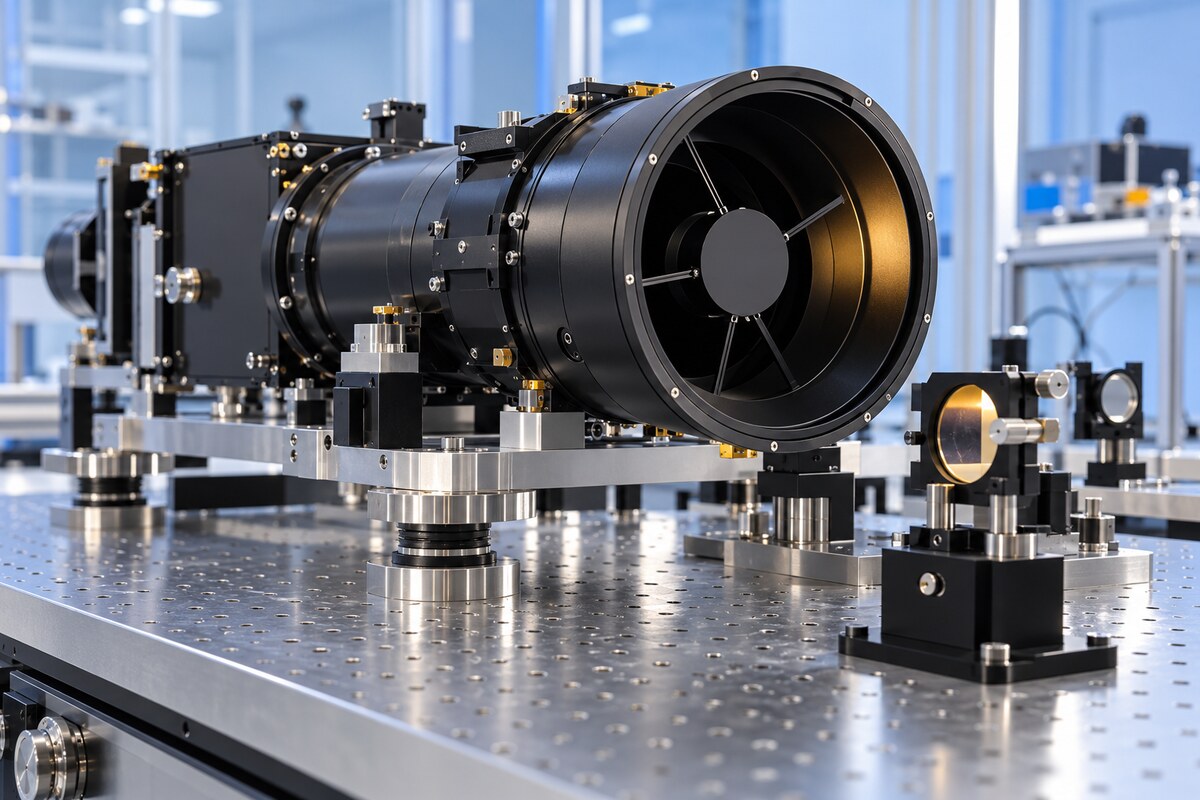
Sener led the industrial consortium, Airbus Defence and Space manufactured the spacecraft, and Redwire handled avionics, assembly and operations. Centre Spatial de Liège built the ASPIICS coronagraph, Spacebel developed onboard and ground software, and GMV was responsible for formation flying and flight dynamics. The scientific instrument was distributed across two platforms: the Occulter would intercept sunlight while the Coronagraph observed from its shadow. ESA’s launch plan placed that observing configuration around 150 metres apart, near the highest part of the orbit, with artificial eclipses intended to last up to six hours.
Why the optical instrument needs separation
Blocking the solar disc does not remove all its unwanted light. Diffraction carries light around the edge of an obstruction, contaminating a view of the much fainter corona. Moving the external occulting disc farther from the telescope reduces this difficulty. Proba-3’s 150-metre operating distance emerged from a trade-off between optical performance, tracking requirements and the propellant needed to hold the spacecraft in position.
The main disc measures 1.4 metres across. Airbus produced it from carbon-fibre-reinforced plastic using a mould from Euro-Composites. A second disc, only 3.5 millimetres across, sits inside the instrument’s central lens and blocks concentrated stray light within the shadow. Together, the external and internal stops support observations much closer to the solar edge than conventional compact externally occulted instruments. The intended inner field reaches approximately 1.1 solar radii. The separation is therefore part of the optical design, while the small internal stop remains necessary despite the considerable distance between the satellites.

An observing cycle built around apogee
The planned orbit extends from roughly 600 kilometres to 60,500 kilometres above Earth, taking 19 hours and 36 minutes. Near the lower end, the spacecraft move much faster and follow safe free-flying paths. Formation acquisition begins as they climb towards apogee and was designed to take about two hours. At high altitude, weaker gravitational disturbances reduce the propellant required for precise relative positioning. Low Earth orbit would have imposed much more demanding corrections.
The Coronagraph acts as flight leader, using a newton-scale hydrazine propulsion system to acquire and break formation and maintain a safe configuration near perigee. The Occulter follows with small nitrogen cold-gas thrusts. After the observing interval, the spacecraft leave active formation and descend on separate safe trajectories. Automatic collision avoidance provides a response if one approaches too closely or develops a fault. ESA’s formation-flight design also includes experiments in changing separation, orientation and rendezvous.
Several measurements guide one alignment
Proba-3 combines absolute attitude measurements with measurements between its spacecraft. Star trackers establish pointing direction. Radio links exchange information, while relative satellite navigation operates on the lower orbital segment, below the GPS constellation. The fine instruments and star trackers share an optical bench to meet the demanding alignment requirements. The formation-management system schedules and plans the activities that use these measurements.

- Cameras on the Occulter detect illuminated LED patterns on the Coronagraph and determine relative position and orientation.
- The Fine Lateral and Longitudinal Sensor sends a laser towards a corner-cube reflector and measures the returned signal for millimetre-scale positioning.
- Photodetectors around the coronagraph lens monitor shadow alignment; unequal illumination prompts a correction.
The Occulter’s precision cold-gas thrusters operate at a scale of 10 millinewtons. The Coronagraph carries a roughly one-newton monopropellant system for perigee manoeuvres and collision avoidance. Onboard autonomous procedures manage most formation experiments, combining the sensors with the different propulsion functions rather than relying on a single measurement method.
Testing the chain from scientist to spacecraft
Before launch, the final system-validation exercise connected the scientific team, mission control and actual spacecraft. Scientists at the Royal Observatory of Belgium sent observing requests to Redu. Controllers processed those requests and transmitted commands to the instruments in Redwire’s Kruibeke cleanroom. The test lasted 12 hours and represented part of the mission’s elongated orbital cycle, including calibration and normal observing scenarios.
This was the fifth in a sequence of increasingly demanding system-validation tests. It used the flight ground-segment facilities and software, together with the people assigned to launch, early operations and subsequent mission control. Commands could also be replaced during the exercise, allowing scientific plans to change in response to exceptional solar activity. ASPIICS kept its protective door closed but returned a recognisable image of its internal coronagraph. The global ground antennas were the exception to the end-to-end rehearsal: those stations did not participate in this test. The returned image therefore checked the command and data path before any solar observation in orbit.

Moving the integrated mission to its launch site
The spacecraft left Redwire’s facilities as a combined mission headed for an Indian launch campaign. Their transport arrangements encountered a practical obstacle: an air-freight company would not initially accept the spacecraft with their batteries installed. Removing the batteries and packing them separately resolved that transport problem. ESA’s Oct 31, 2024, announcement then scheduled the flight to India for Nov 2; that was a transport plan, distinct from the eventual orbital launch.
The integrated pair had a combined mass of about 550 kilograms. Redwire’s responsibilities extended from pre-launch testing into post-launch operations, while GMV worked on formation control, relative satellite navigation and flight dynamics. Spacebel supplied software for the spacecraft and their ground systems. Mission control at Redu was conducting simulations and training before departure. The planned Indian launch would be ESA’s first from that country since the original Proba-1 Earth-observation mission in 2001.
The corona supplies the scientific questions
The solar disc is approximately a million times brighter than the surrounding corona. ASPIICS creates eclipse-like conditions so that the faint atmosphere can be observed without that overwhelming foreground. Its name expands to Association of Spacecraft for Polarimetric and Imaging Investigation of the Corona of the Sun. The two-spacecraft arrangement is an externally occulted coronagraph, with the blocking disc physically separate from the telescope.

Heating and eruptions
The instrument’s scientific goals include examining the corona’s structure, dynamics and heating close to the solar surface. Why the corona is much hotter than the visible surface remains a research question. Another goal concerns coronal mass ejections: large outward releases of solar material that influence space weather. Earlier solar missions observed different temperatures and heights, while sufficiently sensitive, detailed observations within three solar radii remained difficult. DARA and 3DEES complement the optical instrument with total solar irradiance and radiation-belt electron measurements, respectively. These are different measurements serving related solar and near-Earth investigations.
DARA measures the Sun’s energy input
The Sun-facing side of the Occulter hosts the Digital Absolute Radiometer, supplied by the Physical Meteorological Observatory Davos in Switzerland. DARA measures total solar irradiance, expressed in watts per square metre. Its five-millimetre-diameter cavity is made from black-painted silver. Sunlight heats the cavity for 15 seconds; a shutter then closes, and electrical heating maintains the temperature for the next 15 seconds.
The electrical energy required provides the measurement of incident solar energy. An optimised cavity reduces stray light, multiple channels support self-calibration, and digital control permits experiments with faster observations. Position information allows compensation for changes in the apparent solar disc associated with distance. Long records are important because irradiance varies through the solar activity cycle and instruments gradually lose sensitivity under ultraviolet exposure. DARA’s design follows related radiometers flown on NorSat-1 in 2017 and FY-3E in 2021, while its shutter mechanism underwent millions of cycles during vacuum testing.

3DEES uses the radiation-belt crossings
Proba-3’s elongated orbit crosses both inner and outer radiation belts. The 3D Energetic Electron Spectrometer measures electron energies and incoming directions during these passages. Its six viewing directions span 180 degrees. The instrument weighs approximately six kilograms and requires less than eight watts. UCLouvain, the Royal Belgian Institute for Space Aeronomy and Redwire developed it as an in-orbit technology demonstration with scientific-quality measurements.
A panoramic spectrometer module sits on the Coronagraph’s shaded side, with a docking module inside. Three sensor modules each accept particles from two perpendicular directions. Stacks of silicon detectors register deposited energy as particles pass through or stop, allowing their classification. The instrument faces away from the Sun and is scheduled to switch off during formation flying and coronal observations near apogee. Measurements resume where the orbit intersects the radiation belts. Automatic commands can be prepared from the known orbit, without continuous active oversight. This arrangement assigns the electron observations to a different part of the orbital cycle from the main coronal imaging.
January 2025: the connected pair separates
The satellites remained connected for approximately six weeks after launch. At 23:00 GMT on Jan 14, 2025—midnight on Jan 15 in Central European Time—the pair separated while approximately 60,000 kilometres above Earth. Their speed was about one kilometre per second. A clamp band had held metal rings on the two spacecraft together; releasing it allowed them to begin drifting apart.

The control team managed the initial commissioning from Redu, using four ground antennas across Australia, Chile and Spain for communications. The separation sequence was intended to let the satellites drift apart before propulsion arrested that movement and established a stable configuration. Individual spacecraft checks would precede the tightly controlled observing formation. The navigation and propulsion systems then had to bring two independent vehicles into the intended 150-metre alignment. Releasing the mechanical connection was consequently an intermediate operational milestone, following launch and initial checks but preceding the sustained artificial eclipses.
May 2025: closing the precision gap
By ESA’s May 8, 2025, announcement, the satellites had maintained a 150-metre formation for several hours with millimetre precision and without ground control of their relative position. Earlier camera-based flight had established formation, but additional calibration was needed for the desired accuracy. Integrating the calibrated laser instrument into the complete control loop supplied a finer relative-position measurement than the cameras alone.
The shadow-position sensor supplied another essential input. Its light-intensity measurements around the aperture fed an onboard algorithm that kept the Coronagraph within the Occulter’s shadow. Together with navigation, guidance and control software, the sensors supported millimetric accuracy along the spacecraft separation and submillimetric lateral positioning. Formation occurred more than 50,000 kilometres above Earth, where maintaining alignment required little propellant compared with lower flight. The observing configuration was then broken and acquired again on a subsequent orbit. At this announcement, instrument calibration and the first processed coronal image were still ahead, even though the precision formation objective had been achieved.

June 2025: images and supervised autonomy
ESA released the first coronal images on Jun 16, 2025. The Occulter’s 1.4-metre disc cast an approximately eight-centimetre shadow over ASPIICS’s five-centimetre aperture. Each complete coronal view combined three exposures of different duration. The ASPIICS Science Operations Centre at the Royal Observatory of Belgium processed the observations and prepared instrument commands from scientific requests. The resulting images captured faint structures close to the solar edge.
The mission remained in commissioning. Its formation control was autonomous onboard, while ground controllers supervised the activity and were ready to intervene. Routine operation without that monitoring remained an additional objective. The science team was also working to extend observations to six hours per orbit. Alongside direct investigations of the corona, the new images offered material for comparing and refining computer simulations. KU Leuven’s COCONUT model, integrated into ESA’s Virtual Space Weather Modelling Centre, had produced a simulation of the first observations. These early results distinguished successful automatic control from the later operational goal of reduced ground supervision.
December 2025: a longer observing record
By Dec 17, 2025, Proba-3 had produced more than 50 artificial eclipses. Its observing time amounted to approximately 250 hours across 50 orbits. One sequence combined 90 minutes of observations from Jul 16: Proba-2’s SWAP telescope covered the solar disc and low corona, ASPIICS supplied the inner corona, and SOHO’s LASCO C2 captured the outer region. A coronal mass ejection could be followed across these complementary fields.

The inner corona is a region where the solar wind accelerates and many coronal mass ejections originate. Earlier observations there had been infrequent or inconsistent; the spacecraft pair supplied repeated, sustained views between the established observing regions. Proba-3 could create an eclipse once per orbit, with each orbit taking approximately 19 hours and 40 minutes in ESA’s year-end account. During its first year after launch, the mission progressed from attached spacecraft through independent formation flight to accumulated coronal observations. The year-end results also included images linking the inner and outer observing regions.

















Leave a comment