
An observatory built into Antarctic ice
Francis Halzen received the 2026 Nobel Prize in Physics on Oct 6, 2026, for his contributions to the IceCube Neutrino Observatory and the discovery of high-energy astrophysical neutrinos. The Belgian-American physicist is IceCube’s principal investigator at the University of Wisconsin–Madison in the United States. The Royal Swedish Academy of Sciences selected him for an award carrying 12 million Swedish crowns, approximately $1.2 million. IceCube’s international collaboration counted about 450 scientists at 58 institutions in 14 countries. Their instrument detects light from particle interactions inside a cubic kilometre of South Pole ice.
Thousands of independent light detectors
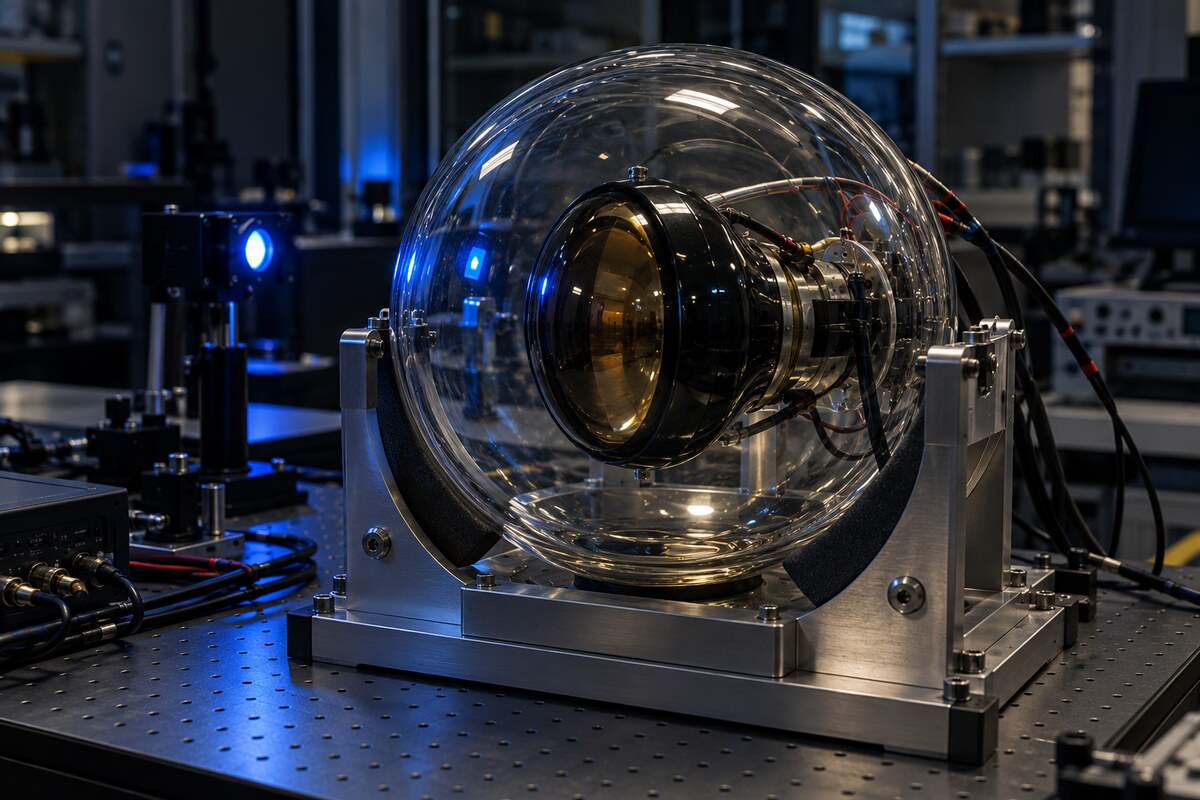
IceCube’s final construction string entered the ice on Dec 18, 2010, completing an array of 5,160 digital optical modules, or DOMs, on 86 strings. Each original module combined a 25-centimetre photomultiplier tube with digitisation and control electronics and twelve calibration LEDs. Its electronics sampled signals at 300 million samples per second; the array’s achieved timing resolution was better than three nanoseconds, against a design requirement below five. Each DOM used less than five watts and was designed to function down to −55°C. The main strings carried sixty modules, generally seventeen metres apart vertically, at depths between 1,450 and 2,450 metres. Twisted-pair connections carried power, measurements, commands and timing-calibration pulses to the surface. Seventy-eight strings occupied a triangular grid with 125-metre spacing; eight additional strings provided denser instrumentation near the centre. The original design specified a fifteen-year module lifetime, a requirement stated when the completed observatory began operating.
Making holes before they freeze
The original drilling campaign required 86 boreholes, each about sixty centimetres wide and 2,500 metres deep. Crews prepared the seasonal equipment and tower sites over roughly four weeks. The equipment site supplied electricity and pressurised hot water from a fixed location, while the drilling towers moved between holes. During the 2009–2010 season, the team drilled twenty holes. Instrumentation manager Jim Haugen described a deployment of 88 people, more than 450,000 litres of fuel and almost 300 tonnes of cargo for that season.

A continuous hose delivered water at about 80°C through an instrumented drill head. During reaming, crews raised the drill while keeping the water flowing, widening the passage and delaying refreezing. After deployment, ice closed around the sensors over approximately a week. A separate firn drill handled the upper fifty metres of compacted snow, which could not retain the water. Mechanical engineer Lee Greenler’s team calculated heat transfer and freeze-back rates to balance fuel consumption against the risk of losing instrumentation in an undersized hole.
Transport, deployment and surface instruments
IceCube’s construction teams shipped 4.7 million pounds of cargo to the South Pole, with personnel, fuel, equipment and detector components arriving in ski-equipped aircraft. Deployment specialists could attach sixty sensors to a cable and lower them to their final depth in eleven hours. Construction accumulated about 28,000 person-days of work. Surface instrumentation continued to develop after the deep array was complete. In December 2015, the team had commissioned an IceAct imaging air-Cherenkov telescope prototype and was collecting background measurements. Its intended next task was to record air showers in coincidence with IceCube after integration and the return of darkness. IceTop, the surface detector, faced a separate problem: snow accumulation reduced tank efficiency. Planned scintillator panels at two stations were intended to recover that lost sensitivity. Winterover training, LED calibration and network upgrades also formed part of the seasonal work at the observatory.
DeepCore and lower-energy particles
DeepCore extends IceCube’s measurements towards lower neutrino energies through closer sensor spacing and placement in particularly clear ice. Modules between about 2,100 and 2,450 metres sit below a major dust layer. Its enhanced photomultiplier tubes offered approximately 35% greater quantum efficiency, helping the detector reach energies around ten gigaelectronvolts. IceCube’s astrophysical searches commonly examine neutrinos above 1,000 GeV, so this lower threshold supports a different part of the scientific programme within the same observatory.
At the June 2012 neutrino conference in Kyoto, Andreas Gross of the Technical University of Munich presented an analysis of neutrinos between ten and one hundred GeV using DeepCore data. The study concerned muon neutrinos changing into tau neutrinos, an example of neutrino oscillation. These measurements investigated changes between neutrino types at energies above the reach of some earlier oscillation measurements. The closely instrumented core therefore supported particle-property studies alongside IceCube’s searches for the sources of much more energetic cosmic neutrinos.
Keeping a detector configuration stable
IceCube’s IC86-2017 run began on May 18, 2017, after operations staff tested updates to the data-taking and monitoring systems. Operations manager John Kelley explained that the detector configuration remained stable for a year, making the run transition the opportunity for major changes. A new geometry, calibration and detector database supported sensor-response calibration. An upgraded monitoring system gathered, tested and displayed operational information for the people responsible for maintaining data quality.
The ESTReS starting-track selection extended real-time searches towards ten-TeV events, below the sixty-TeV selection discussed for HESE; developer Kyle Jero expected up to three additional astrophysical neutrinos annually. That was a forecast for the selection. During the preceding IC86-2016 run, detector uptime reached 99.75%, while clean uptime with every string taking data was 97.65%. These were different operating measures. An aircraft-induced radio-interference incident raised the signal rate by half and cost about ninety minutes of data, without further damage to the acquisition systems.
The ice is part of the measurement
A neutrino interaction produces secondary charged particles, whose Cherenkov light travels through the ice to the optical modules. Reconstructing the event’s direction and energy requires an optical model of that journey. IceCube observed in 2013 that a light source’s apparent brightness depended on the direction of propagation. Researchers initially tried describing this anisotropy through changes in impurity-driven scattering and absorption. The later SpiceBFR model instead incorporated birefringent propagation through the structure of the ice crystals.
In October 2022, the collaboration described simulations of light travelling through polycrystalline ice with crystals elongated along the ice-flow direction. The model produced a mean deflection of the light. Martin Rongen and colleagues compared simulated paths with calibration measurements from about 60,000 LEDs distributed through the detector, using the comparison to infer average crystal shapes and sizes. The work treated crystal properties through modelling and calibration data. Those properties also interest glaciologists studying how Antarctic ice flows.
Known flashes for calibration
LED flashers produce pulses with known intensity, position, orientation and wavelength during dedicated calibration runs. For the Upgrade, engineers developed systems for both the multi-PMT digital optical module, or mDOM, and the Dual optical sensors in an Ellipsoid Glass for Gen2 module, known as D-Egg. More than 5,000 small flasher boards, each approximately twenty-five by fifteen millimetres, were produced and tested before integration into the mDOMs. Testing checked that the two module families could provide interchangeable calibration performance.

Teams in Japan, Germany and the United States coordinated production and individual board checks. By Aug 8, 2025, the flashers had been incorporated into the sensor modules. The deployment plan at that date called for seven new strings during the 2025–2026 Antarctic summer. Rongen outlined an initial programme of checking the instrumentation’s timing and photomultiplier amplification, followed by collecting measurements for new ice models. These calibration tasks concern the detector response as well as the ice surrounding it.
A diffuse flux before individual sources
IceCube announced solid evidence for an astrophysical neutrino flux on Nov 21, 2013. Researchers selected twenty-eight high-energy events from observations collected between May 2010 and May 2012, examining events above fifty teraelectronvolts across the sky. The combined signal exceeded four sigma and could not be explained by the expected atmospheric-neutrino and cosmic-ray-muon backgrounds alone. The result concerned the statistical properties of a sample; it did not supply an individual astronomical address for every detected event.
Most neutrinos passing through Earth originate in the Sun or Earth’s atmosphere, while the far rarer high-energy cosmic population can carry information about extreme accelerators. IceCube’s original research goals separated measuring that population’s flux from identifying its sources. Collaboration spokesperson Olga Botner described continuing work to improve the observation’s significance and understand its origin. The 2013 result, published in Science, used the completed detector’s sensitivity after years of observing atmospheric neutrinos and developing event-selection methods.

An alert and a distant blazar
On Sep 22, 2017, IceCube detected a neutrino with an estimated energy of approximately 300 TeV and sent an alert to other observatories. Follow-up observations associated its direction with TXS 0506+056, a blazar about four billion light-years away near Orion. NASA’s Fermi satellite identified enhanced gamma-ray activity, and MAGIC in the Canary Islands detected still higher-energy gamma rays. About twenty observatories contributed observations across the electromagnetic spectrum, providing evidence for the blazar as a high-energy neutrino source.
A blazar’s central black-hole environment launches jets, one oriented towards Earth. Charged cosmic rays change direction in magnetic fields, whereas electrically neutral neutrinos can preserve information about their arrival direction. After the alert, IceCube researchers searched archival data and found an excess of more than a dozen neutrinos from the same direction during late 2014 and early 2015. The 2018 source studies combined that independent historical observation with the single-event alert and telescope follow-up.
A nearby galaxy with an obscured centre
NGC 1068, or Messier 77, provided another source investigation in November 2022. The barred spiral galaxy lies about forty-seven million light-years away in Cetus. It is a Seyfert II active galaxy, whose central black-hole environment is obscured by a torus of dust. Halzen described a sample of approximately eighty teraelectronvolt-energy neutrinos associated with NGC 1068. These observations concerned particles produced in the surrounding energetic environment, where neutrinos can escape material that obscures electromagnetic radiation.

The analysis improved upon an earlier 2020 study. IceCube spokesperson Ignacio Taboada attributed the advance partly to updated detector calibration and partly to improved analysis methods, which sharpened directional reconstruction. Hans Niederhausen described models in which gas, dust and radiation block gamma rays that would otherwise accompany neutrinos. The NGC 1068 investigation therefore involved both the astronomical source’s obscured environment and the observatory’s ability to reconstruct a neutrino’s direction from light collected deep beneath the South Pole.
Searching the Galactic plane
In June 2023, IceCube presented evidence for high-energy neutrino emission from the Milky Way. The analysis used about 60,000 neutrinos spanning ten years, thirty times the event count of an earlier Galactic-plane cascade analysis. Researchers compared the observations with prediction maps, including one extrapolated from Fermi Large Area Telescope gamma-ray measurements and two KRA-gamma models. Cosmic rays interacting with Galactic gas and dust were expected to produce both gamma rays and neutrinos.
Drexel University researchers developed selections for cascade events, whose light resembles a roughly spherical shower starting inside the instrumented volume. These selections reduced atmospheric contamination. TU Dortmund researchers applied machine-learning methods to improve event identification and reconstruction of direction and energy. Co-lead analyst Mirco Hüennefeld described a threefold sensitivity improvement over the preceding search. The Galactic-plane evidence did not resolve every contributing source: Taboada identified finding specific sources within the galaxy as the next question for follow-up analyses.

The completed Upgrade and commissioning
IceCube’s Feb 12, 2026 completion announcement reported five new, densely instrumented strings in the bottom centre of the original array, adding more than six hundred light sensors and calibration instruments. This was the completed configuration, whereas the August 2025 LED programme had described a seven-string plan. The construction programme comprised three consecutive ten-week Antarctic field seasons between 2023 and 2026. Early seasons refurbished and tested equipment and established the drill camp; drilling and installation took place in the final season.
A five-megawatt hot-water system drilled each new hole in approximately three days. Teams then installed mDOMs, D-Eggs and specialised calibration devices, including cameras and prototype equipment for a possible larger observatory. The deployment announcement distinguished installation from commissioning, which remained a priority to verify device functionality. Better ice characterisation was intended to improve reconstruction and enable reanalysis of fifteen years of archived observations, alongside more precise measurements of atmospheric-neutrino oscillations.
Operations, archives and responsibilities
The National Science Foundation renewed a five-year, $53 million cooperative agreement with Wisconsin–Madison for IceCube operations and maintenance during 2026–2031. The August 2026 announcement described more than 5,500 optical modules in 91 boreholes, together with 58 new special and calibration devices. Two winterovers maintained the observatory through each Antarctic winter. Kelley described integration of the Upgrade equipment as progressing, with physics data from it expected later in 2026.

Six institutions supporting core operations
- Lawrence Berkeley National Laboratory: distributed computing and the long-term data archive.
- University of Delaware: IceTop maintenance.
- University of Maryland: software, online filtering and simulation coordination.
- University of Alabama at Tuscaloosa: detector calibration.
- Michigan State University: software and simulation production.
- University of Utah: operation of new Upgrade calibration devices.
The maintenance programme also planned changes to surface and Northern Hemisphere computing hardware, including replacement of surface data-acquisition electronics that were about twenty years old. Software development for processing and analysing Upgrade measurements was another planned task.
The larger Gen2 proposal
IceCube-Gen2 remains a proposed extension. Its August 2020 white-paper design combined optical and radio measurements. The optical concept included 120 new strings roughly 240 metres apart, arranged to avoid long corridors between sensors. Modules would be separated by sixteen metres vertically at depths of approximately 1.3 to 2.6 kilometres. That design would instrument nearly eight cubic kilometres of ice. Its radio component covered approximately five hundred square kilometres with stations carrying antennas on shallow strings, intended to observe radio emission from particle showers.
The collaboration projected ten times the annual cosmic-neutrino observation rate and five times IceCube’s point-source sensitivity for that concept. A 2033 completion date and construction cost around $350 million were forecasts presented in 2020. They were not completed work or a newly guaranteed schedule in 2026. The October 2026 Nobel announcement still described Gen2 as a proposal, while the smaller Upgrade had been installed. The two projects occupy different stages of the observatory’s development.

















Leave a comment