

EarthCARE reaches orbit
EarthCARE, a joint mission of the European Space Agency and the Japan Aerospace Exploration Agency, has launched aboard a SpaceX Falcon 9 rocket from Vandenberg Space Force Base in California. Liftoff took place on May 28, 2024, at 15:20 local time, corresponding to May 29 at 00:20 CEST. The satellite separated from its launcher about ten minutes into flight.
The Earth Cloud Aerosol and Radiation Explorer made contact with the Hartebeesthoek ground station in South Africa less than an hour after launch. Mission controllers at ESA’s European Space Operations Centre in Darmstadt, Germany, will monitor the spacecraft and calibrate its instruments during commissioning. Initial data were expected six months after launch.
Four instruments for atmospheric observations
Airbus led the spacecraft’s development, construction and testing in Friedrichshafen, involving experts from fifteen European countries, Japan and Canada. The spacecraft weighs 2.3 tonnes and extends eighteen metres with its solar panel and radar deployed. Its planned Sun-synchronous polar orbit is around 400 kilometres above Earth, with a mission lasting at least three years.

EarthCARE will measure natural and human-made aerosols, the distribution of water droplets and ice crystals, and their movement within clouds. Its observations are intended to improve climate modelling and weather forecasting. The measurements concern both sunlight reflected back into space and infrared radiation trapped within the atmosphere.
The instrument package
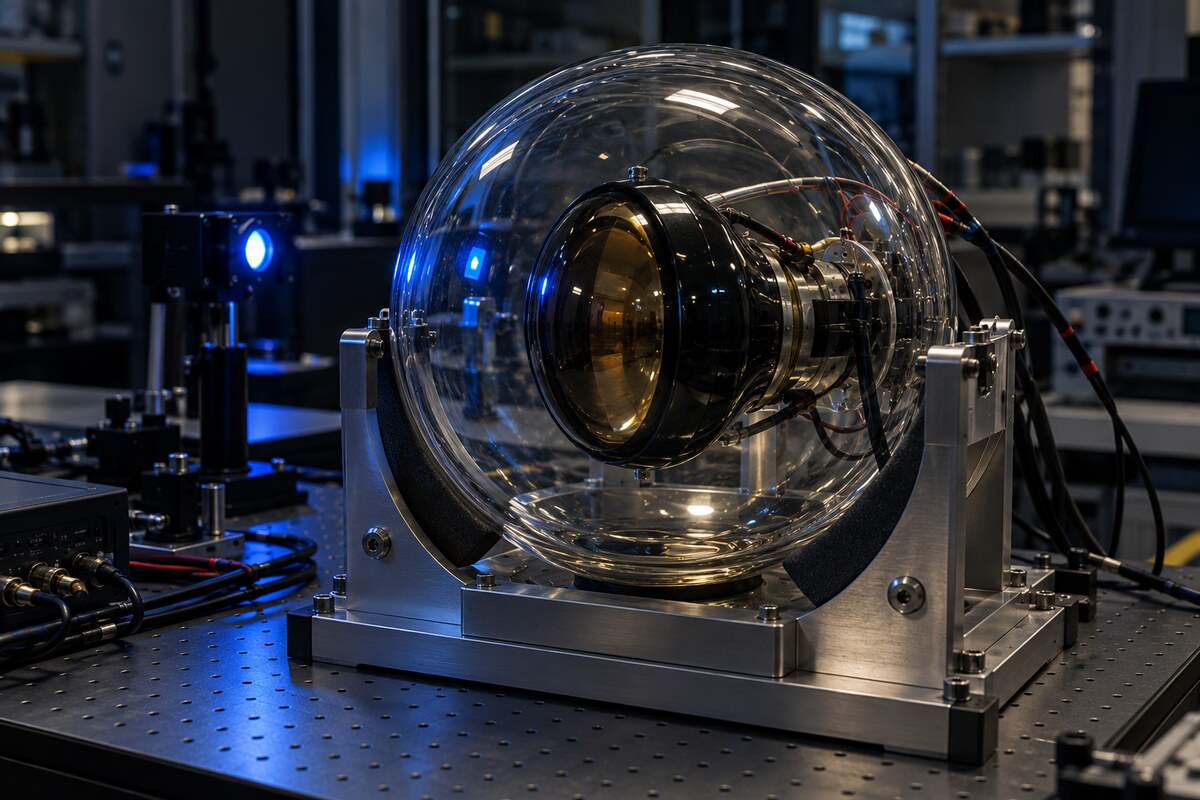
- Airbus atmospheric lidar ATLID for aerosol and thin-cloud profiles.
- JAXA Cloud Profiling Radar.
- Surrey Satellite Technology Limited Multi-Spectral Imager.
- Broad-Band Radiometer developed through European industry.
Airborne checks planned for the satellite data
DLR’s HALO research aircraft will carry four instruments comparable to EarthCARE’s payload for a three-part validation campaign. The DLR Institute of Atmospheric Physics and the Max Planck Institute for Meteorology will lead the work. Airborne and ground measurements will be compared with the satellite observations.
The first measurement flights are planned from Cape Verde in August 2024, supported by ground observations from the Leibniz Institute for Tropospheric Research. HALO is then scheduled to move to Barbados in September, where the Max Planck Institute for Meteorology will accompany the flights with ground measurements.

HALO will subsequently return to Oberpfaffenhofen for autumn flights over Europe, the extratropical North Atlantic, the Alps and the Mediterranean. Many flights will pass directly beneath EarthCARE to obtain comparable measurements from the spacecraft, aircraft and ground stations.
German researchers will also examine data-product quality through the GIVE project. A project office at Ludwig-Maximilians-Universität München will support researchers’ use of the mission data.




















Leave a comment