
A short-lived signal from a stellar pair
Einstein Probe detected EP J0052 in the Small Magellanic Cloud on May 27, 2024. Its Wide-field X-ray Telescope triggered observations with the satellite’s Follow-up X-ray Telescope, NASA’s Swift and NICER. ESA’s XMM-Newton found no remaining signal 18 days later. Alessio Marino of the Institute of Space Sciences in Spain led the study in The Astrophysical Journal Letters.
Researchers propose a Be star weighing 12 solar masses and an approximately solar-mass, Earth-sized white dwarf. Hydrogen drawn onto the dwarf becomes compressed until runaway nuclear burning produces a flare. Their evolutionary model starts with two stars exchanging material, leaving a heavier Be companion and a stripped stellar core. This is an interpretation of the observations.

ESA astronomer Ashley Chrimes associated the system with a rarely observed evolutionary phase; project scientist Erik Kuulkers highlighted the difficulty of catching these soft-X-ray outbursts. Principal investigator Yuan Weimin described an international science team of about 300 researchers. The discovery involved international scientists.
Wide surveys and detailed follow-up
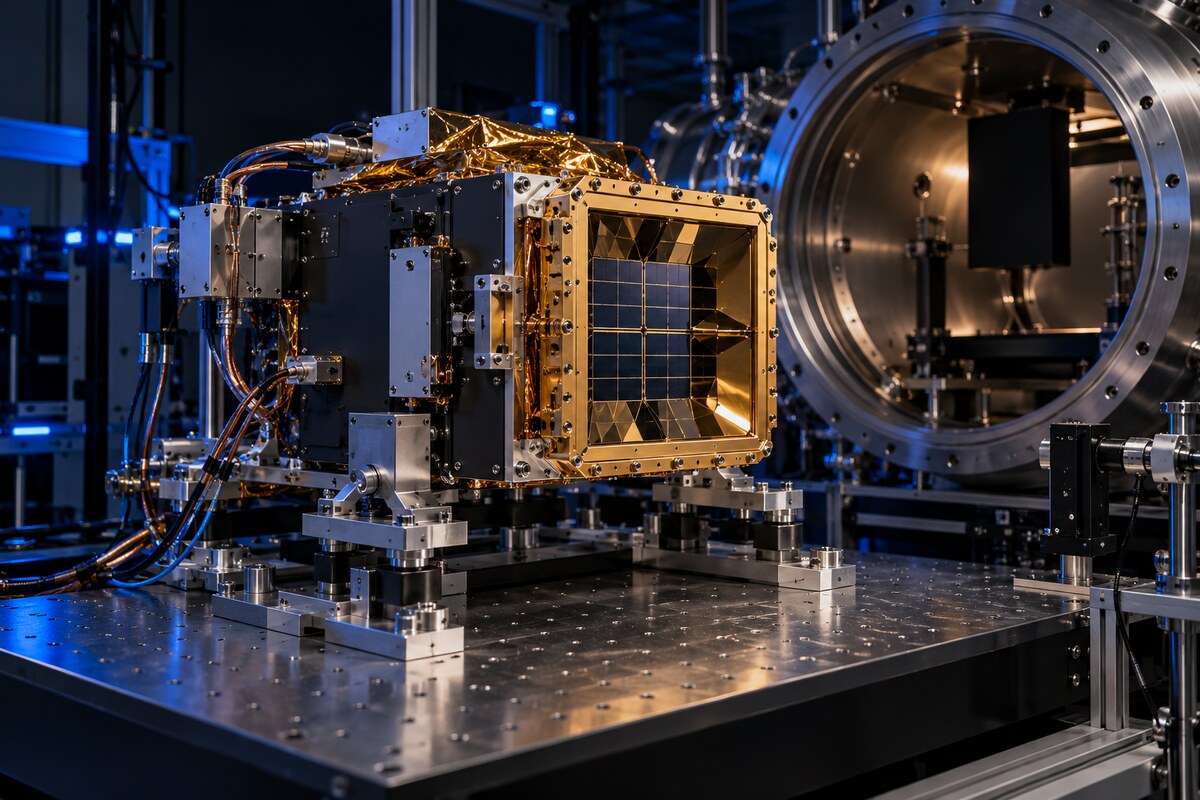
Einstein Probe combines twelve wide-field modules with two follow-up telescopes. The wide-field instrument’s lobster-eye optics had already been tested in space by LEIA, the Lobster Eye Imager for Astronomy, in 2022. Together, the twelve modules cover more than 3,600 square degrees and can monitor the entire night sky in three orbits. Detected sources have a characteristic cross-shaped appearance produced by the optics.

Two observing roles
- WXT searches a broad area for changing X-ray sources.
- FXT studies selected sources with greater sensitivity and detailed views.
- Other ground-based and space telescopes can extend observations into additional wavelengths.
FXT completed a time-critical follow-up on March 20, 2024, during calibration. ESA and the Max Planck Institute for Extraterrestrial Physics contributed key FXT components. ESA also supported WXT detector and optics testing and calibration. The April 2024 first-light milestone preceded the binary-star detection.
An observatory above the atmosphere
A Long March-2C rocket launched the approximately 1.45-tonne observatory from Xichang Satellite Launch Center in Sichuan Province, China, at 3:03 p.m. Beijing time on January 9, 2024. X-rays cannot penetrate Earth’s atmosphere, so space-based instruments provide access to this radiation from energetic celestial activity. The mission’s targets include white dwarfs, neutron stars, supernovae and gamma-ray bursts.

The satellite’s onboard computer processes transient detections in real time and turns the spacecraft so FXT can investigate the source. Its instrumentation also includes CMOS sensors developed for space X-ray observations. The launch programme included participation by ESA and the Max Planck Institute for Extraterrestrial Physics in Germany.




















Leave a comment