
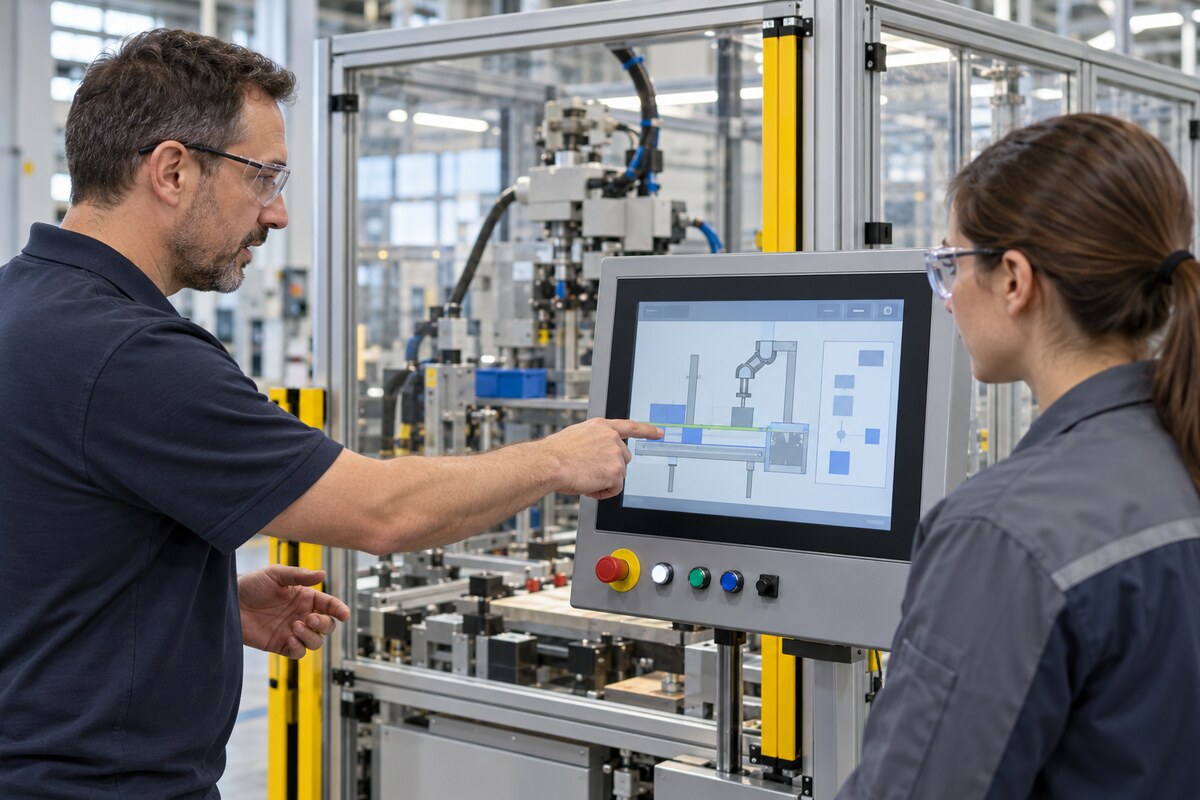
Consultation alongside the software
Freudenberg involves employees in data collection and consultations during AI integration, according to Vishwanath Hegadekatte, its senior manager of future technologies in North America. The manufacturer demonstrates its systems and software to workers, including internally developed models alongside Microsoft Copilot. Hegadekatte described direct conversations about intended process improvements and gradual changes introduced with employees’ knowledge.
BSI’s global head of human and social sustainability, Kate Field, recommended continuing question-and-answer sessions, refresher training and additional preparation for employees acting as technology champions. Google Cloud manufacturing-solutions head Praveen Rao recommended small pilots and tools compatible with existing workflows before wider deployment. These are approaches to managing adoption, rather than guarantees against displacement.

Confidence and concern coexist
Boston Consulting Group’s June 26, 2024 survey findings covered 13,102 employees across 15 countries and regions, from frontline employees to executives. Most respondents held office-based roles. Among regular generative-AI users, 49% believed their jobs might disappear within ten years, compared with 24% of nonusers. That comparison records expectations among different respondent groups; it does not count jobs eliminated by the technology.
Training and learning barriers
- Insufficient time to learn the tools.
- Training that did not work effectively.
- Uncertainty about when to use generative AI.
Training access also differed by position. Only 28% of frontline employees and 30% of managers had received training on how AI would change their jobs, compared with half of leaders.

Respondents also described putting time saved through generative AI into additional tasks, new tasks, experimentation and strategic work. BCG recommended broader training and preparation for changing roles, skills, operating models, data and governance. Its workforce sample extends beyond manufacturing and should not be treated as a factory-floor survey.
Earlier manufacturing and finance evidence
The OECD’s July 11, 2023 employment findings included a survey of workers and companies in manufacturing and finance across seven OECD countries. At that stage, the organization found little evidence of negative employment effects among firms adopting AI. Workers and employers reported benefits from reducing tedious and dangerous tasks, including greater engagement and physical safety. Those reported experiences coexisted with concerns about future employment and working conditions.

Three in five workers worried that AI could remove their jobs entirely within ten years. A similar share worried about lower wages in their sector. Three in four said AI had increased work pace, and more than half expressed privacy concerns. These findings concern respondents’ experiences and expectations, rather than a projection that the same proportion of jobs would disappear. The OECD called for employers to provide more training and for education systems to incorporate AI skills. Its recommendations also covered transparency and accountability in employment decisions supported by AI, alongside privacy, safety, fairness and labour rights.





















Leave a comment