
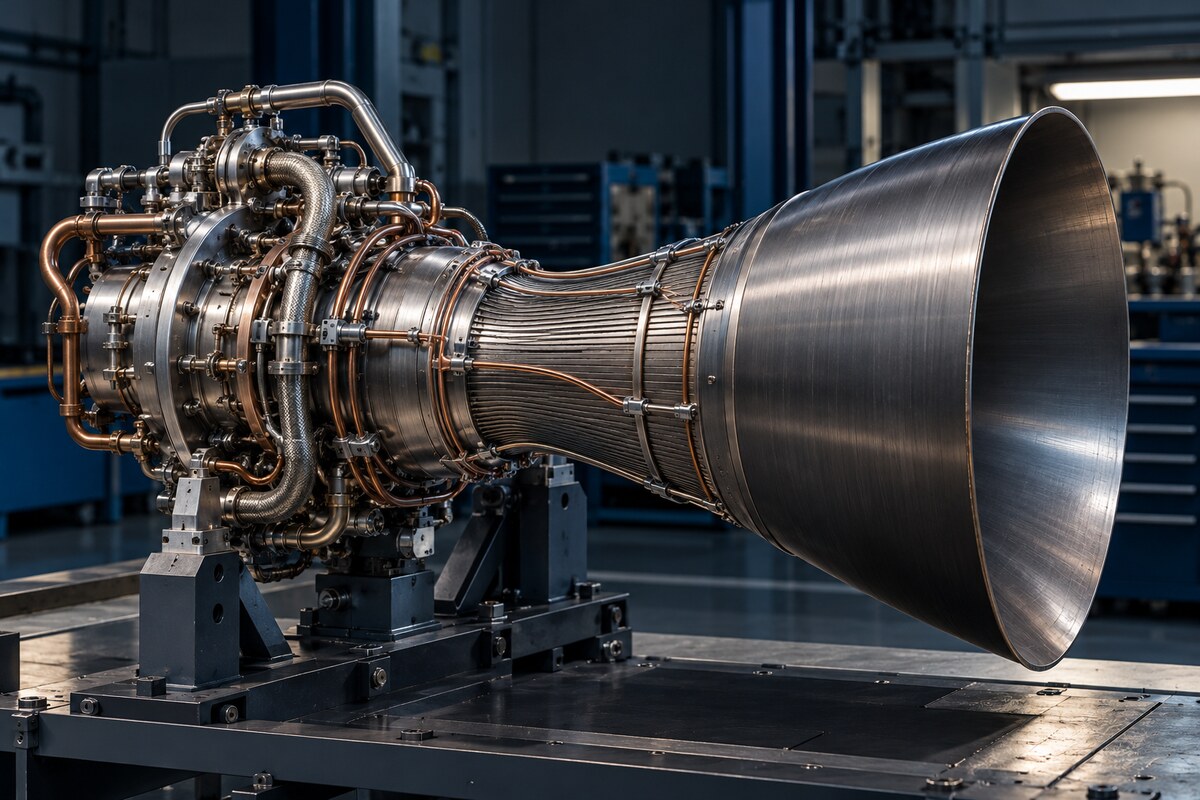
Ariane 6 approached its debut on 9 July 2024 with a demonstration mission carrying satellites and experiments from European agencies, companies and universities. The 56-metre rocket had originally been due in 2020. A small problem in a ground data-acquisition system pushed the earliest launch time back an hour, to 19:00 GMT. The nearly three-hour flight was a test mission, preceding commercial operations. Ariane 5 had retired, Western ties to Russian Soyuz had been cut, and Vega-C was grounded.
ArianeGroup, owned by Airbus and Safran, developed the launcher at an estimated cost of €4 billion. ESA countries had agreed to the programme in 2014 amid growing competition from SpaceX. Before the debut, roughly 30 customer missions were in the queue, including 18 for Amazon’s Kuiper constellation, conditional on a successful introduction. ESA space-transportation director Toni Tolker-Nielsen emphasised sovereign access for government missions; former UK Space Agency deputy chief Ian Annett cautioned that competitiveness still needed improvement.
Testing the stages before flight
Ariane 6’s upper stage underwent a firing test at the German aerospace agency DLR’s Lampoldshausen site on 1 September 2023. Its restartable Vinci engine operated for 680 seconds across two burns. The auxiliary propulsion unit, or APU, also operated in two bursts alongside Vinci. Engineers examined the two propulsion systems working together, a necessary part of the upper stage’s restart capability. This was a ground qualification exercise, months before Ariane 6’s first orbital demonstration.

A separate rehearsal at Kourou on 5 September 2023 tested the combined launcher and launch pad. Vulcain 2.1 fired for four seconds before the onboard software shut it down as intended. The sequence covered checks preceding booster ignition and liftoff. Preparations for a longer firing subsequently uncovered an anomaly in the hydraulic equipment for thrust-vector control, which steers the engine to maintain the rocket’s attitude. Further investigation displaced the test from its planned 3 October date.
A full countdown on the ground
On 23 November 2023, the test launcher completed a much longer rehearsal at Europe’s Spaceport in French Guiana. Teams fuelled the vehicle, ran a launch countdown and ignited its core-stage Vulcain 2.1 engine. A small anomaly interrupted the automated sequence before ignition; the countdown was reset and restarted. The subsequent engine firing lasted more than seven minutes, covering the core-stage operating phase represented by the rehearsal.
The solid boosters remained unlit, keeping the test vehicle on its pad throughout. Almost 150 tonnes of liquid oxygen and hydrogen from the core-stage tanks supplied the firing. The rehearsal combined propulsion operations with the surrounding ground equipment rather than sending a vehicle into space. Thousands of monitoring points around the launch pad collected data for detailed analysis and preparations for the first flight. The live coverage continued until after core-stage operations had finished and the engine had consumed its propellant.

Clearing the test installation
The combined testing campaign eventually gave way to dismantling the test model and preparing the pad for the first flight vehicle. On 30 January 2024, teams completed disconnection and retraction of the cryogenic supply systems at Kourou. These operations removed connections used during testing and opened the way for clearing the launch installation. The task force’s January assessment considered the propellant-based combined test phase finished, with no additional tests required on the flight model.
The remaining preparation included rehearsing disassembly of the launcher, an operation needed if a future anomaly required replacement of a stage on the pad. A separate dummy-payload removal exercise was also planned in the final assembly building. Meanwhile, investigators were still examining an upper-stage hot-fire test that had stopped after two minutes on 7 December 2023. As of 31 January, that investigation had not changed the target window of 15 June–31 July 2024 for the inaugural launch.
Transporting the first flight stages
The main and upper stages crossed the Atlantic aboard Canopée, a transport ship designed around Ariane 6 cargo. They arrived at Pariacabo harbour in Kourou on 22 February 2024 after a ten-day voyage covering more than 7,000 kilometres. Canopée collected the upper stage in Bremen, Germany, then called at Le Havre in France for the main stage. Both stages belonged to the launcher intended for the inaugural mission.
The hybrid vessel is 121 metres long and uses 37-metre-tall sails. Its wind-assisted design was intended to reduce fuel consumption by up to 30%, rather than guaranteeing that saving on every voyage. The ship accommodates large, delicate rocket components and can navigate the shallow Kourou river to the harbour. After unloading, the stages continued by road to the nearby launch vehicle assembly building, where they were unpacked and placed on the integration line for preparation ahead of liftoff.
Three propulsion systems with different jobs
Ariane 6 combines solid boosters with two liquid-propellant stages. Each P120C booster carries 142,000 kilograms of solid propellant and produces about 3,500 kilonewtons of thrust over roughly 130 seconds. Two or four boosters can be fitted according to the mission. Once ignited, a solid motor consumes its charge to completion. Europropulsion, the ArianeGroup–Avio venture, developed these boosters for the Ariane and Vega launcher families.
The core-stage Vulcain 2.1 burns liquid hydrogen and oxygen, producing about 1,371 kilonewtons of thrust. Its ignition equipment sits on the launch pad, reducing equipment carried by the rocket. The upper-stage Vinci delivers 180 kilonewtons and can restart in space. Its APU pressurises the cryogenic tanks and supports ignition when gravity cannot feed propellant towards the engine as it does on the ground. Multiple burns allow orbital adjustments and payload deliveries, with a final firing available to bring the stage towards atmospheric reentry after its passengers have separated.

A launch complex built around the vehicle
CNES built and operates the ELA4 launch complex. Construction began in 2015, and qualification finished in 2023. The site’s deep rocky ground supports the launcher and its surrounding mobile gantry. That 90-metre structure moves 120 metres along rails in about 20 minutes before launch. Arms supplying the upper stage with cryogenic propellant are 13 metres long and weigh 20 tonnes; they can retract in less than 2.3 seconds to clear the departing rocket.
A water-deluge system suppresses the intense acoustic environment at liftoff. Water reaches flame deflectors and exhaust channels, then is recovered and recycled. A control bench processes more than 20,000 data points per second, including measurements of temperatures, pressures, valves and propellant systems. Separate transport equipment brings the large components into position: a purpose-built booster carrier can support 250 tonnes on 36 wheels, with sideways steering for manoeuvring. Automated guided vehicles move the assembled central core along a route designed to avoid twisting it during transfer to the pad.
What the inaugural flight completed
Ariane 6 lifted off on 9 July 2024. The first upper-stage burn established an elliptical orbit, followed by a 35-minute coast and a second Vinci ignition. That second burn circularised the orbit at 580 kilometres. Eight satellite missions separated successfully: Robusta-3A, Replicator, Curium One, GRBBeta, CURIE, ISTSat-1, 3Cat-4 and OOV-Cube. Commands also activated five experiments that remained aboard. The flight therefore included both deployed spacecraft and attached experimental equipment.
The final technology demonstration did not complete its intended sequence. The APU started again but stopped, preventing a third Vinci burn that would have put the upper stage onto a reentry trajectory. The onboard software instead passivated the stage, removing stored energy to reduce explosion risk. Two reentry capsules remained attached, avoiding additional independently orbiting objects. The 31 July mission assessment separated these unfinished demonstrations from the completed satellite deliveries; its investigation into the APU behaviour was still open.
Different experiments shared the ride
CURIE’s two viewpoints on solar radio bursts
NASA’s CUbesat Radio Interferometry Experiment, CURIE, carried a scientific objective tied to solar activity. Two spacecraft were designed to launch joined together, with separation into CURIE A and B planned after deployment. Measurements from two locations would let researchers use interferometry to reconstruct where detected radio signals originated. The experiment was designed to examine emissions associated with solar eruptions, including flares and coronal mass ejections, and track the movement of radio-burst source regions away from the Sun.
The intended observing range was 0.1–19 megahertz. Earth’s ionosphere absorbs such radio waves, making a space-based experiment necessary for these measurements. CURIE’s planned 580-kilometre orbit matched the altitude selected for the inaugural satellite deployments. The small spacecraft were also a technology pathfinder: the project sought to establish whether relatively inexpensive CubeSats could support a dedicated space radio interferometer. These were the mission’s scientific and engineering objectives at launch; deployment alone did not establish that the observations or analysis had been completed.

YPSat’s early wake-up call
ESA’s Young Professionals Satellite, YPSat-1, was designed to stay attached to the upper stage while filming fairing separation and payload deployments. About 45 early-career professionals worked on its design, construction and testing. The team included trainees, junior professionals, research fellows and interns from across the agency. Hosted equipment added other tasks: OscarQube used quantum-based sensors to measure Earth’s magnetic field along the trajectory, while an AMSAT antenna supported amateur-radio communication.
Filming fairing separation required the equipment to wake earlier than many conventional satellite missions. Project manager Tuur Strobbe’s team developed an autonomous wake-up system using several sensors to recognise liftoff and determine progress through the launch sequence. The ground team prepared to receive telemetry at ESA’s ESOC control centre. Communications windows were limited by the upper stage’s rotation, with only one orbit envisaged for recovering data. The original plan also anticipated filming through the stage’s disposal; the unsuccessful final burn changed that planned ending.
Robusta-3A links weather measurements and electronics tests
Robusta-3A, a 30-centimetre CubeSat from the University Space Center of Montpellier, was designed to study water vapour over the Mediterranean. Its meteorological experiment was intended to collect reflected navigation signals, including signals from Galileo. Researchers planned to compare the space measurements with observations from navigation receivers carried by ships. Météo-France would use the differences to improve understanding of moisture associated with severe rainfall and flash floods affecting southern France, including the Cévennes region.

A second experiment was designed to test how memory supplied by French electronics company 3D PLUS withstood space radiation. Around 300 students from Montpellier and other institutions participated over more than a decade of development. The weather payload involved Météo-France, IGN, Ensta Bretagne and the port of Sète. Two Montpellier laboratories supported the radiation experiment. Robusta-3A combined environmental observation, electronics testing and practical training in one small platform; better forecasts remained an intended application of the measurements, rather than a result established by the rocket’s delivery of the satellite.
The upper-stage investigation
The Ariane 6 task force completed its initial investigation into the interrupted demonstration during August 2024. Its 16 September update identified a temperature measurement that had exceeded a predefined limit during preparation for APU ignition. The flight software responded by shutting the unit down. The upper stage entered its long coast without the intended APU thrust, disrupting the later demonstration sequence. As a consequence, the software did not command Vinci’s third ignition.
Engineers planned to change the APU ignition-preparation sequence, specifically its chill-down procedure, to improve starting conditions. The revised software was already undergoing tests when the September update appeared. The identified remedy concerned the preparation sequence; the investigation did not describe an accomplished third burn on the first flight. The task force maintained that no issue identified in its initial analysis prevented a second mission. Satellite deployment, the aborted demonstration and the subsequent software work remained separate parts of the programme’s progress.

Qualifying the more powerful configuration
Further qualification continued after the debut. In November 2024, an upper-stage test model underwent five tests at different sound levels in ESA’s Large European Acoustic Facility, LEAF, in the Netherlands. ArianeGroup used the model previously fired during the 2022–2024 campaign at Lampoldshausen. These acoustic tests addressed the four-booster configuration, whereas the first flight had used two boosters. ESA expected the four-booster vehicle to expose the upper stage to 60% greater acoustic pressure.
The model stood upright, reproducing its orientation at liftoff. Water and glycerine filled tanks that would contain liquid oxygen and hydrogen in flight, making the test loading more representative. Two hundred sensors recorded the structure’s response to sound. Test covers recreated surrounding intertank structures and acoustic protection from the main stage. More than six metres tall, the upper-stage model was the largest and heaviest object yet tested inside LEAF. The week of testing qualified it for the harsher acoustic environment associated with the four-booster launcher.
The commercial flight completed the disposal sequence
Ariane 6’s second flight took place on 6 March 2025, rather than within the 2024 schedule envisaged after the debut. Mission VA263 departed French Guiana at 13:24 local time, or 16:24 GMT, in the two-booster configuration. Arianespace operated this first commercial mission, carrying the French CSO-3 satellite for the procurement agency and CNES on behalf of the French Air and Space Force’s Space Command. The satellite separated about one hour and six minutes after liftoff into a Sun-synchronous orbit around 800 kilometres high.

The second flight’s upper-stage operations included the missing elements of the inaugural demonstration:
- The auxiliary propulsion unit reignited after payload delivery.
- Vinci completed its third burn.
- The upper stage entered a reentry trajectory and was disposed of through Earth’s atmosphere.
That completed sequence followed the satellite’s delivery, giving the second mission both an operational payload outcome and a demonstrated end-of-flight disposal manoeuvre.










Leave a comment