
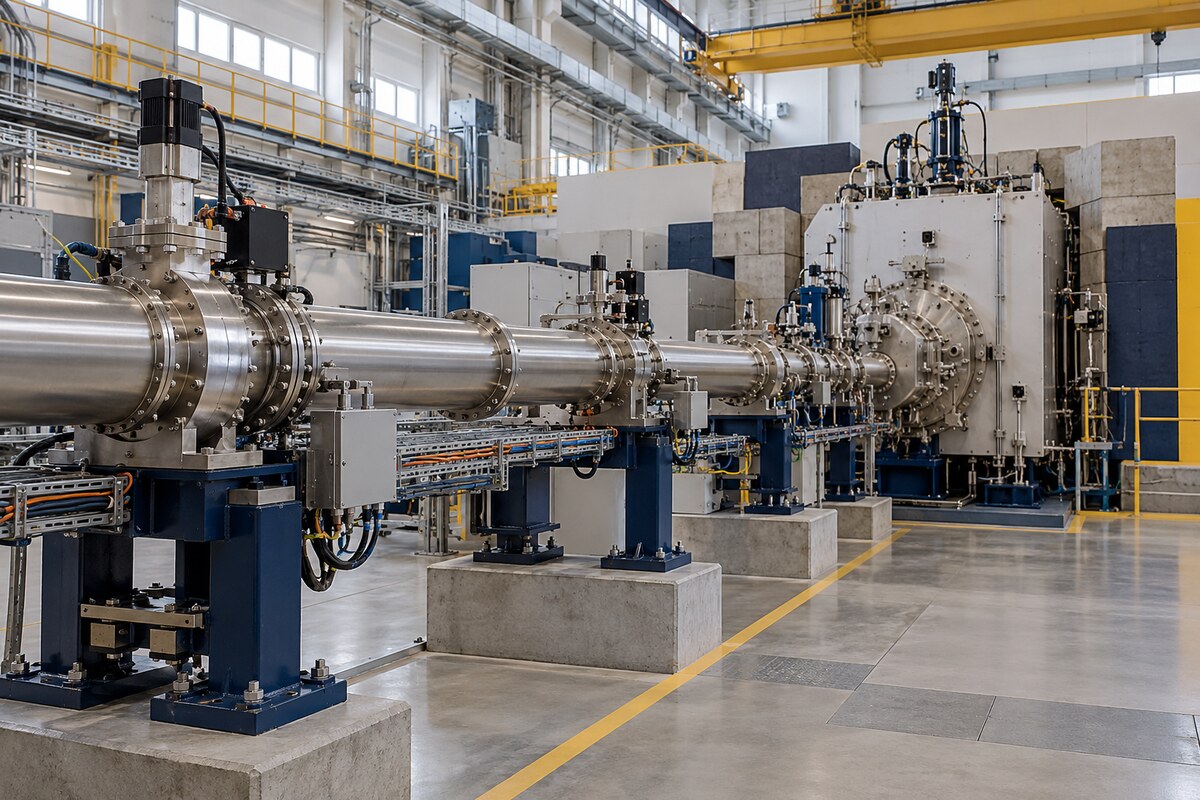
The China Spallation Neutron Source in Dongguan, Guangdong Province, is expanding its experimental infrastructure. The Phase II launch on Mar 30, 2024 introduced a programme for 11 additional neutron instruments, experimental terminals and user laboratories in China.
Wang Sheng, deputy director of the Institute of High Energy Physics and the project's general director, described a planned increase from the original 100 kW beam-power design to 500 kW. He expected construction to take five years and nine months. Subsequent milestones below retain their actual 2024–2026 dates; the higher design target remains distinct from measured operating power.
From protons to neutron pulses
The target station converts a high-energy proton beam into neutron pulses for scattering instruments. Its 2024 design description specifies protons with an energy of 1.6 GeV and a light-water-cooled tungsten target. Proton interactions with the tungsten produce fast neutrons through spallation. Hydrogen and water moderators then provide cold, thermal and epithermal neutron pulses, with different energy distributions for the instruments.

Flat tungsten plates and a single-layer container keep the target close to the moderators. The Phase II target-station plan retains a fixed solid target and this compact arrangement at the proposed 500 kW level. Changes include replacing light water with heavy water for cooling the target and beryllium reflector. Thermal-hydraulic simulations inform the handling of components with different risk levels, while post-irradiation examination forms another part of the development work. These are features of the upgrade plan, rather than confirmation that the entire higher-power station is already operating.
Superconducting acceleration and cooling
The linear accelerator's superconducting addition is designed to raise the linear-section energy from 80 to 300 MeV. Under the June 2025 AFAD engineering specifications, ten double-spoke cryomodules contain two cavities each, operating at 324 MHz, and eight elliptical cryomodules contain three cavities each, operating at 648 MHz. Both module types have a specified working temperature of 2 K.
The cryogenic design calls for refrigeration capacity of 850 W at 2 K. That cooling specification is separate from the proton beam's kilowatt power rating. Double-spoke modules are 2.506 metres long between flanges; elliptical modules are 4.454 metres long. Both designs place the beamline 1.5 metres above the floor and specify a thermal shield at 60 K. Engineers compared distributed small heat exchangers with a more centralised arrangement. The distributed scheme permits individual modules to cool down or warm up and provides independent vacuum isolation. Engineers selected that approach on maintenance and technical-feasibility grounds. Module production, testing and tunnel installation remained scheduled work leading towards the project's 2029 completion target.

Measured power milestones
160 kW in March 2024
CSNS reached stable beam delivery at 160 kW on Mar 4, 2024, before the public Phase II launch. The previous operating round had reached 140 kW. During the Spring Festival shutdown, the accelerator team installed a magnetic-alloy-loaded cavity and a momentum collimator. Beam commissioning began on Feb 18 and took approximately two weeks.
The preparation included machine studies and physical simulations between operating periods. During commissioning, the team adjusted the linear accelerator's beam-pulse width, synchrotron operating conditions, injection settings and orbit correction. It also worked on instability suppression and longitudinal beam dynamics. IHEP reported that the higher-power operation had a better beam-loss level than the preceding 140 kW round. The figure describes beam power on the target; it does not represent electrical output from the facility.
A further increase followed on Oct 11, 2024, when beam power on target reached 170 kW. Two magnetic-alloy-loaded cavities installed in the Rapid Cycling Synchrotron supported that step. The December 2024 announcement treated the result as part of validating the technical approach for the larger CSNS-II power upgrade.

185 kW in March 2026
CSNS achieved stable beam delivery at 185 kW on Mar 4, 2026. Work towards that level had started on Feb 4. A comprehensive upgrade to the full-energy injection system in 2025 had significantly changed the beam dynamics of the Rapid Cycling Synchrotron. Upgraded ring radio-frequency equipment and power supplies added further changes to the accelerator configuration.
Linear-accelerator hardware limitations and energy jitter complicated beam simulations during the March 2026 commissioning. Differences between calculated behaviour and actual measurements were a central obstacle during commissioning. The resulting stable supply established a new operating milestone after the two 2024 increases. IHEP expects higher power to shorten some user experiments and improve facility utilisation. Those anticipated benefits are separate from the measured 185 kW result, which remains below the 500 kW design objective.
A beamline for developing neutron technology
The Neutron Technology Development Station delivered its first neutron beam on Mar 5, 2026, and entered beam commissioning. It was the first CSNS-II beamline to reach that stage. The milestone followed completion of its equipment development and installation; preliminary beam-performance tests met the team's expectations. First beam and commissioning are distinct from a declaration of routine operation for all proposed user services.

The station is a time-of-flight beamline for testing cold and thermal neutrons. Its development involved small-angle beam splitting, rapid switching between operating modes and repeatable positioning at experimental end stations. Low background and efficient use of beam time are design characteristics of the test environment. Once operational, the station is intended to support work on materials, devices, measurement methods and metrology. Proposed uses include development and batch testing of neutron detectors, guides, polarizers and choppers. These are components of neutron instruments, rather than a list of scientific samples that have already been measured on the new station.
Different instruments, different measurements
By January 2023, CSNS had completed nine neutron instruments, including four newly constructed systems. Their capabilities span engineering components, structures across several length scales, internal imaging and atomic-scale dynamics:
- EMD: strain, stress and texture measurements in engineering materials.
- VSANS: very-small-angle scattering and multiscale structural characterisation.
- ERNI: energy-resolved neutron imaging combined with diffraction.
- HD: medium- and high-energy inelastic neutron scattering.
EMD supports mechanical loading and fatigue studies under different temperature conditions. VSANS covers structures from 0.3 to 1000 nanometres and offers sample environments including magnetic fields and rheometry. ERNI combines radiography, tomography and crystallographic measurements to examine interiors and material structures. Its penetrating neutrons can reveal structural information several centimetres inside components. HD, constructed with Sun Yat-sen University, measures changes in neutron energy as well as scattering distribution. Its specified incident-energy range is 10–1500 meV, with an optimal energy resolution of 3%, temperatures of 1.5–800 K and magnetic fields up to 7 T. The figures describe different measurement dimensions, rather than a single common performance scale.

Total scattering at the Multi-Physics Instrument
The Multi-Physics Instrument was built jointly by CSNS, Dongguan University of Technology and City University of Hong Kong. A technology appraisal took place in Dongguan on Aug 12, 2024. The instrument supports total-scattering studies of structures with different degrees of order, with research spanning materials science, physics, chemistry and environmental questions.
Principal investigator Yin Wen reported more than 300 user experiments over three years and more than 100 research publications. Those counts concern MPI, rather than every experiment at the neutron source. Applications included batteries and energy materials, alloys, rare-earth materials and magnetism. The instrument team developed position-sensitive helium-3 tube detectors and software for neutron diffraction and data reduction. MPI also supports the CityU–IHEP Joint Laboratory on Neutron Scattering and the Guangdong–Hong Kong–Macao Neutron Scattering Science and Technology Joint Laboratory. These partnerships connect a particular instrument's research programme with institutions participating in its construction and use.
Polarized neutrons and magnetic materials
A polarized-neutron experimental platform had been established at CSNS by the 2025 International Conference on Polarized Neutrons in Condensed Matter Investigations. The meeting ran from Feb 24 to 28 in Dongguan and brought together more than 70 experts from over 20 institutions and universities. Its scientific focus included experimental platforms, applications and further development of polarized-neutron methods.

The technique is used to investigate magnetic thin films, magnetic-storage materials, high-temperature superconductors and quantum materials. Its applications also extend to spintronics, polymers and biological materials. Wang Sheng said that more than half of the 20 planned CSNS beamlines would incorporate polarized-neutron capabilities. That statement concerns the intended instrument portfolio, rather than 20 completed new beamlines. The established platform is intended to support measurements relevant to superconducting applications and improvements in electric-motor efficiency. Training discussions covered the underlying theories, spectrometer techniques and current research questions associated with polarized-neutron scattering.
Experiments on molecular sieves and ceramics
Two General-Purpose Powder Diffractometer user projects produced published results in 2024. An April Nature study investigated ZEO-5, a stable three-dimensional molecular sieve with a 20 × 16 × 16-membered channel system. The researchers worked at Jilin University, East China Normal University, Nanjing University and the Materials Research Institute in Madrid. The research combined neutron diffraction with three-dimensional electron diffraction, synchrotron powder X-ray diffraction, aberration-corrected scanning transmission electron microscopy and solid-state nuclear magnetic resonance. The combined measurements established detailed structural information about the material.
A July Science study examined large-deformation tensile plasticity in ceramics at room temperature. Neutron-diffraction data were used to quantify dislocation density. The team proposed introducing dislocations from metals as a strategy for obtaining tensile deformation in the ceramics studied. The GPPD contribution therefore concerned quantitative structural measurement within a wider materials investigation. These are two identified experiments with different samples and research questions: the molecular-sieve work concerns a channel structure, while the ceramic work concerns defects and deformation.

Looking inside historical metal objects
The Guangdong Provincial Museum used the energy-resolved imaging instrument for research on five artifacts. Examples included a Han Dynasty iron sword, Qing Dynasty gilded copperware and calibrated copper weights from the Guangxu period. Neutron measurements revealed internal information in the metal objects, adding another application for the facility's imaging capability alongside its engineering and materials experiments.
The gilded copperware presented a particular imaging challenge. Neutrons penetrated its metal walls and allowed researchers to examine the interior without damaging the bottom cover. The museum work was discussed at a symposium held in Dongguan from Nov 26 to 29, 2024, hosted by CSNS, the Palace Museum and the Guangdong Provincial Museum. More than 100 specialists attended, with 30 presentations involving museum researchers and instrument scientists. Participants included the National Museum and the Museum of the First Emperor of Qin, with instrumentation specialists from CSNS, the Hefei Light Source and the China Institute of Atomic Energy.
A separate programme for muons
CSNS-II also includes the MELODY Muon Experimental Terminal. At the Second Muon Application Workshop on Jan 10–11, 2025, more than 70 specialists discussed the terminal's construction and multidisciplinary research requirements. Participating facilities included Rutherford Appleton Laboratory, J-PARC and the Paul Scherrer Institute, alongside universities, research institutes and cultural-heritage organisations.

The discussions addressed the planned muon spin rotation, relaxation and resonance spectrometer, commonly abbreviated µSR. The proposed station would support investigations in condensed-matter physics, magnetic materials, new-energy materials and superconducting materials after completion. Domestic participants included the University of Science and Technology of China, Fudan University, Shanghai Jiao Tong University, the Songshan Lake Materials Laboratory and the Palace Museum. MELODY's development programme brings together instrument scientists and prospective experimental users. It is a muon platform within the wider upgrade, separate from the neutron-scattering instruments and from the Neutron Technology Development Station that entered beam commissioning in March 2026.
How a user experiment is organised
A historical CSNS call illustrates the practical sequence for outside researchers. For the October 2023–February 2024 experimental period, proposals were due by Jul 31, 2023. Applicants created an account and submitted the research background, objectives, experimental methods, expected results and estimated beam time. Expert review assessed scientific merit before experiments were scheduled.
The user office then notified successful applicants by email, followed by online access registration. An experimental report and satisfaction survey were required within three months of the experiment. The call offered GPPD, the Multipurpose Reflectometer, the Small Angle Neutron Scatterometer and MPI. GPPD had completed a stress-testing upgrade, so that round primarily sought stress studies. Some systems were still undergoing performance development, and users were asked to provide feedback during commissioning. These are arrangements for that dated proposal round, rather than a current invitation or an assurance that the same instruments and deadlines apply to a later visit.

Training for measurement and analysis
The 2024 CSNS Neutron School brought 35 students from 19 institutions to the campus on Nov 20–24. Courses focused on neutron powder diffraction, scattering fundamentals, operation of spectrometers and use of the GSAS and FullProf analysis programs.
Teaching included crystallographic space-group symmetry, structure refinement and worked examples of structural analysis. Scientists from powder-diffraction, multiphysics and high-resolution diffraction instruments introduced their systems and guided experimental operations and data analysis. The school supplied a distinct training setting alongside the facility's instrument-development programme and its scheduled user experiments.


















Leave a comment