
DUNE and Hyper-Kamiokande are being built to compare neutrinos with their antimatter counterparts and investigate the imbalance between matter and antimatter. The two international collaborations use different detector technologies, with large underground installations in the United States and Japan.
In May 2025, Sanford Underground Research Facility science director Jaret Heise described the South Dakota caverns as ready for detector construction. Sussex physicist Kate Shaw highlighted the combination of engineering, computing and experimental technology behind DUNE. Imperial College London's Mark Scott expected Hyper-K to gain sensitivity earlier because of its timetable and detector size. Queen Mary University of London's Linda Cremonesi argued that establishing differences between neutrinos and antineutrinos required more than reaching the first measurement. Their expectations concerned experiments still under construction. Neither collaboration had established that neutrinos explain the universe's matter abundance.
Excavating DUNE's underground home
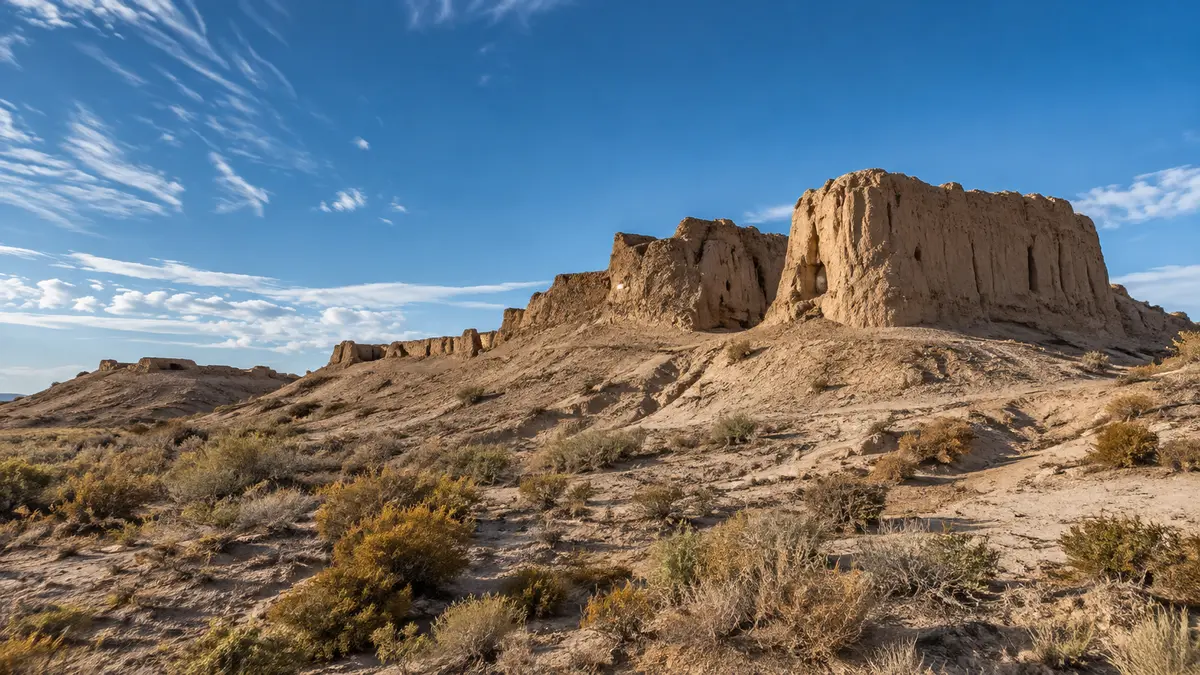
DUNE's far-detector caverns occupy the former mining environment at Lead, South Dakota. Excavation finished before Fermilab announced the milestone on Feb 1, 2024. Two detector caverns, each more than 500 feet long and approximately seven storeys high, accompany a third cavern for utilities. Together with connecting passages, the underground development occupies an area comparable to eight soccer fields.

Crews worked 4,850 feet below the surface. Heavy mining machines could not arrive intact through the existing shaft: workers dismantled them, transported their parts underground and reassembled them at depth. Blasting and rock removal continued for about two years. Almost 800,000 tons of excavated rock travelled to the Open Cut, a former surface mining area. The caverns provide room for four detector modules. At the February 2024 milestone, outfitting and installation remained subsequent work. Project managers then aimed to operate the first detector before the end of 2028. That was a dated construction goal; later schedules changed. The excavation announcement also identified CERN prototype testing and component mass production as separate parts of the preparation programme.
Steel structures before detector assembly
DUNE's underground construction entered another stage in May 2026. CERN Director-General Mark Thomson joined officials at Sanford on May 7 for a ceremony marking preparations to lower the structural steel. Approximately 4,500 tonnes of beams were scheduled to descend 1.5 kilometres underground, according to CERN's May 11 announcement.
The steel forms structural elements for two planned detector modules. Each module was described as roughly the size of a five-storey building. Thomson signed one beam intended for the first module. The ceremony marked a construction milestone, while the lowering and assembly programme remained work to be carried out. CERN supplies the two large cryostats and contributes to prototype-detector development. Thomson placed that work within scientific cooperation with American laboratories, which also supply superconducting accelerator magnets for CERN's High-Luminosity Large Hadron Collider. The cryostat structures belong to DUNE's detector infrastructure. The planned detector modules remained under construction at that milestone. The planned experiment connects Fermilab's beam source with the South Dakota instruments across a distance of approximately 1,300 kilometres.

Testing the near detector with neutrinos
DUNE also needs a detector close to the beam source at Fermilab. A four-module demonstrator tests the technology for that location. The modules sit in a square arrangement, giving the device its 2×2 name. Installation in an existing beamline finished in February 2024; the team announced its first recorded accelerator-produced neutrinos on July 10.
Berkeley Lab developed the LArPix pixel sensor and electronics system for inherently three-dimensional images. The prototype has more than 337,000 charge-sensitive pixels spaced at approximately four-millimetre granularity. Liquid-argon time projection chambers record tracks, while light detectors provide complementary information. The final liquid-argon near-detector design described in August 2024 envisaged 35 modules, each larger than a demonstrator module. The near site presents an intense experimental environment. Collaborators expected approximately 50 interactions per beam pulse in the future detector, rather than an isolated track in every image. The demonstrator used Fermilab's existing beam, operating in antineutrino mode during the described tests. Its measurements support studies of particles produced when antineutrinos interact with argon. These prototype observations precede operation of DUNE's full near-and-far system.
Wire panels built for the far detector
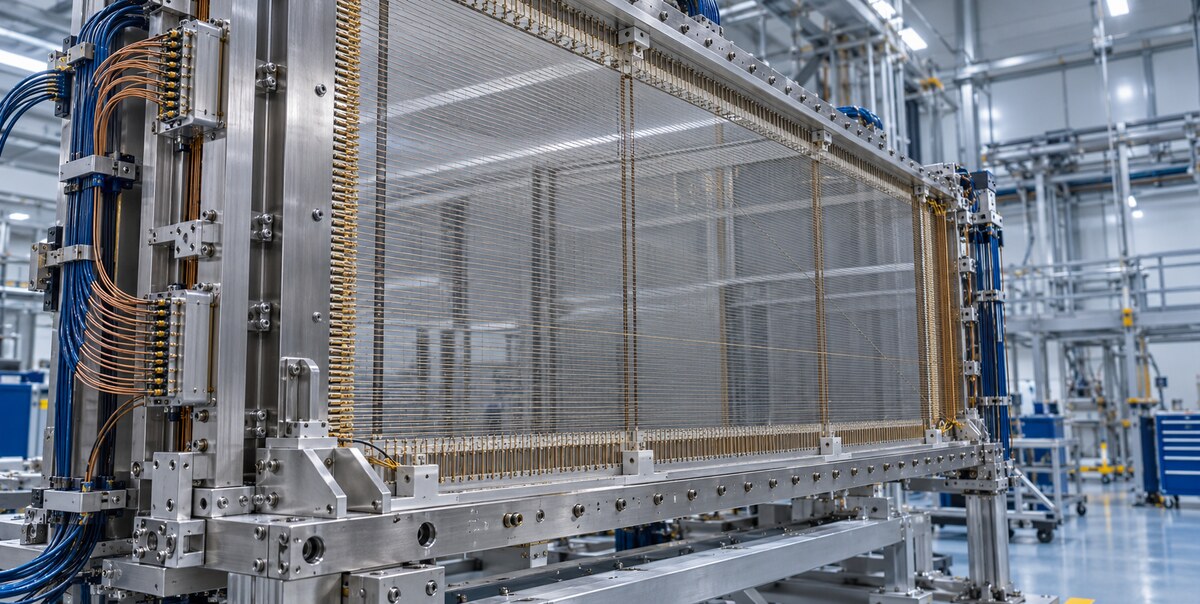
DUNE's far detector uses large readout structures called Anode Plane Assemblies. UKRI reported on Oct 19, 2026 that half of the British production allocation was complete. The United Kingdom is responsible for 137 of the 150 assemblies specified for Far Detector 1.

A team of 25 technicians at Daresbury Laboratory manufactures the panels, working with universities that supply components, quality assurance and scientific leadership. Each panel stands approximately 6.3 metres tall and 2.3 metres wide. Around 24 kilometres of thin copper-beryllium wire run across its frame, with thousands of precision connections holding the readout structure together. Charged particles produced in neutrino interactions leave ionisation signals in the argon. The wire assemblies detect those signals so that researchers can reconstruct particle positions and movement. The production programme includes testing before underground installation. Eight completed assemblies had reached Fermilab for final testing by the October announcement. UKRI scheduled completion of the remaining British panels by May 2029. The halfway milestone refers to the stated production allocation; it does not mean that half of the complete DUNE experiment was installed or operating.
Combining charge tracks and scintillation light
Liquid argon supplies two kinds of information about an interaction. Charged particles ionise the liquid along their paths. An electric field moves the liberated electrons towards the readout plane. The same interactions also produce scintillation light. A photon-detection system measures this light to establish interaction timing, particularly for events outside the accelerator beam.
The timing information helps determine how far the electrons drifted, supporting three-dimensional reconstruction and rejection of particles entering from outside. Argon's scintillation wavelength, approximately 127 nanometres, lies in the vacuum-ultraviolet range. DUNE's X-Arapuca devices use wavelength-shifting materials and dichroic filters to trap photons and guide their shifted light to silicon photomultipliers. At CERN, ProtoDUNE-HD tested full-scale components with a maximum horizontal electron drift of 3.6 metres. Its photon system contained 160 X-Arapucas behind four wire assemblies. During ten weeks of beam exposure between June and September 2024, the prototype received electrons, protons, pions, kaons and muons. Approximately 30 million beam and cosmic interactions were collected. Preliminary photon-system studies examined calibration stability and the relationship between detected light and deposited energy.

Purity, cooling and the mine shaft
DUNE's cryogenic design must preserve both the liquid and the faint electrical signals travelling through it. The October 2025 cryogenic design requires oxygen-equivalent contamination below 30 parts per trillion, corresponding to a free-electron lifetime exceeding ten milliseconds. The temperature-gradient requirement was below one kelvin. These are full-detector design requirements.
Purification filters remove moisture and oxygen, while liquid recirculation supports purification and thermal uniformity. Condensers help control pressure. Membrane cryostats avoid the continuous vacuum pumping associated with vacuum insulation, but their design must accommodate heat loads and prevent underpressure. Prototype operating measurements are separate from the requirements for the future installation. The Ross shaft imposes a further mechanical constraint: cryogenic equipment must fit a width envelope below 1.33 metres during lowering. That restriction favours multiple long, narrow valve boxes. For each of two detector condenser systems, the October design envisaged 15 valve boxes, approximately 700 metres of cryogenic transfer lines and 120 cryogenic valves. Tendering, manufacture, delivery and filling were still scheduled stages. The dimensions describe equipment designed for underground installation, rather than an already commissioned cooling plant at DUNE.
Transporting the accelerator's cold hardware
The Proton Improvement Plan-II programme upgrades Fermilab's accelerator complex for the neutrino programme. Its superconducting linear accelerator was designed to extend approximately 215 metres. The ten-metre HB650 cryomodule is the largest module type in that machine, with four planned for its final section.

A prototype weighing approximately 12,500 kilograms completed a transatlantic transportation test in late 2023. It left Fermilab on Nov 27, flew to Luxembourg and travelled by truck to Daresbury Laboratory. After testing there, it returned along the same route, reaching Fermilab on Dec 14. A custom frame developed under British leadership supported the journey.
The transport programme first used concrete blocks reproducing the module's dimensions, mass and mounting points. The fully equipped prototype then tested actual handling and logistics. Fermilab completed that prototype in early 2023, incorporating superconducting cavities contributed by India's Raja Ramanna Centre for Advanced Technology. The shipment tested arrangements needed for future British-built production modules. Three assembled British cryomodules were expected as a contribution as of January 2024. Moving the prototype successfully was a transport result, distinct from installing those later production units.
Japan's beam upgrades already in use
Hyper-K builds on accelerator and detector experience from T2K. That existing experiment sends neutrinos from J-PARC in Tokai towards Super-Kamiokande, approximately 300 kilometres away. T2K began taking data in 2010 and began antineutrino measurements in 2014.

Upgraded beam operation started in December 2023. A January 2024 announcement described stable operation at about 710 kilowatts and continuous operation at 760 kilowatts on Dec 25. The electromagnetic-horn current increased from 250 to 320 kiloamps, improving the focusing of charged particles that subsequently decay into neutrinos. Further increases towards 1.3 megawatts remained part of the upgrade plan.
The near-detector installation, 280 metres from the production target, added three complementary systems:
- SuperFGD uses scintillator cubes and optical fibres to reconstruct particle tracks.
- High-angle time projection chambers measure tracks and momentum over a wider angular range.
- Time-of-flight detectors help establish particle direction and identification.
Those measurements improve knowledge of neutrino interactions before oscillation analysis. T2K's earlier indications concerning matter-antimatter symmetry required more precise measurements; the upgrade announcement did not establish a discovery of CP violation.

Excavating Hyper-K's water-detector cavern
Hyper-K's main cavern excavation finished on Jul 31, 2025 in Hida City, Gifu Prefecture. The University of Tokyo announced completion on Aug 5. Approximately 330,000 cubic metres of rock had been removed, with completion around six months later than originally scheduled.
The cavern has a dome approximately 69 metres in diameter and 21 metres high above a cylindrical section approximately 73 metres high. These are excavation dimensions. Geological surveys, boreholes and measurements of rock movement informed the shape and reinforcement. Dome excavation began in November 2022, with shotcrete and prestressed anchors stabilising successive stages. Excavation of the cylindrical section began in October 2023.
A central shaft, 3.4 metres in diameter, carried excavated rock to the bottom access tunnel for removal by trucks. Further reinforcement required large scaffolding. After excavation, the programme moved towards a tank designed for 260,000 cubic metres of ultra-pure water. The August announcement scheduled detector-structure construction in 2026, component installation by 2027 and operation in 2028 after filling. Each future date belongs to that published construction schedule, rather than a statement that the work was already complete.

Light collection in water
Hyper-K uses water Cherenkov detection. Charged particles moving through its ultra-pure water produce light that photomultiplier tubes record. The far detector lies on a 295-kilometre baseline from the accelerator, at an angle of 2.5 degrees from the beam axis.
The optical layout separates an inner detector from an outer region that identifies incoming particles. The inner fiducial mass is 188 kilotonnes in the July 2025 design. Its large inner photomultipliers and smaller outward-facing sensors serve different functions: recording interactions in the target volume and rejecting external backgrounds.
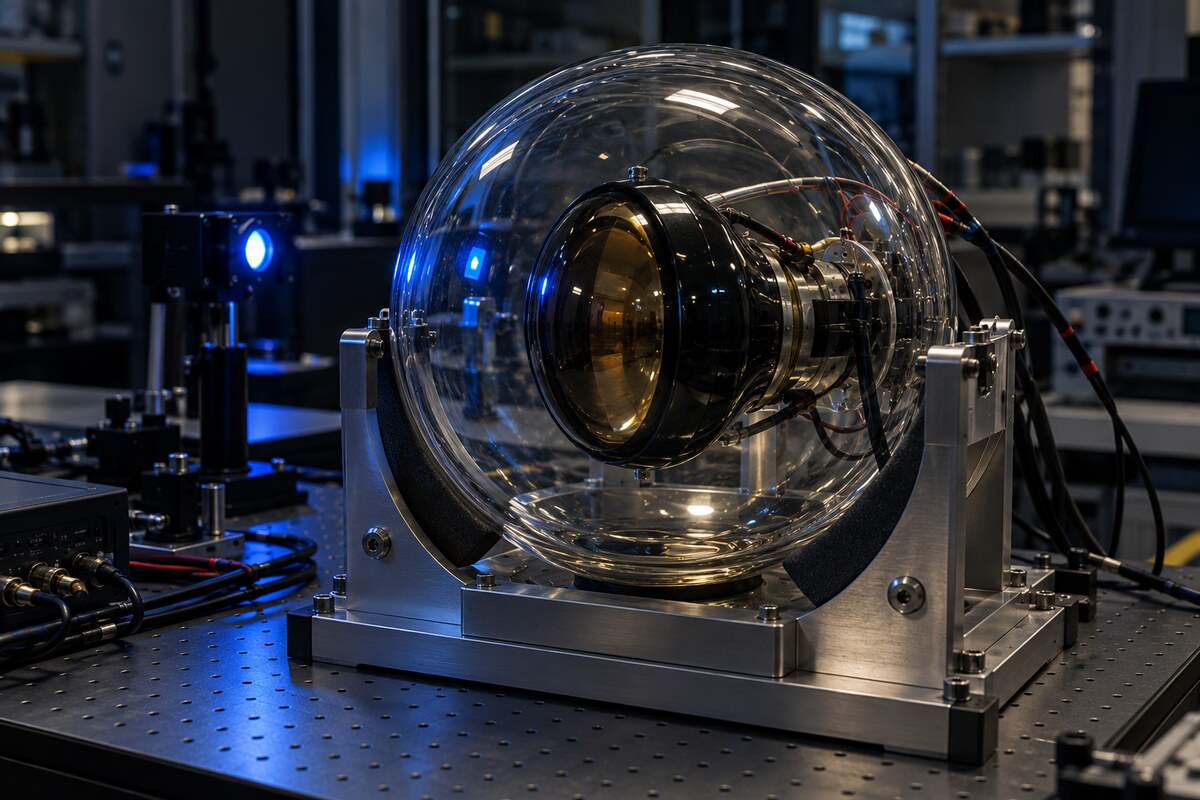
The electronics design places digitiser and power-supply equipment inside watertight underwater vessels. Shorter connections between sensors and electronics reduce analogue cable length. Optical cables carry digitised signals to the acquisition system outside the water. Engineers must test reliability before filling, because submerged equipment becomes difficult to access. GPS receivers and a rubidium clock supply timing references. The wider programme also includes an intermediate water detector designed to move vertically through different beam angles, providing measurements of neutrino interactions relevant to interpreting the distant detector's observations.

A programme with several construction stages
DUNE brings together the detector collaboration, the Long-Baseline Neutrino Facility and PIP-II accelerator upgrades. Its June 2026 fact sheet placed installation of the first detector in 2026 and the start of its operation in 2029. These milestones refer to the first detector, rather than completion of every proposed module or the entire accelerator programme.
The earlier sequence includes groundbreaking in 2017, the first ProtoDUNE detector coming online at CERN in 2018, Fermilab site preparation in 2019 and the start of main cavern excavation in 2021. Underground excavation finished in 2024. Components for the first two of four planned modules entered mass production, with testing at CERN and work on near-detector components at Fermilab.
Neutrinos will travel through the earth between Illinois and South Dakota without a connecting tunnel. The research programme includes comparisons of neutrino and antineutrino behaviour, searches for physics beyond the Standard Model and observations of neutrinos from exploding stars. These are intended measurements. Their scientific outcomes remain open questions.













Leave a comment