
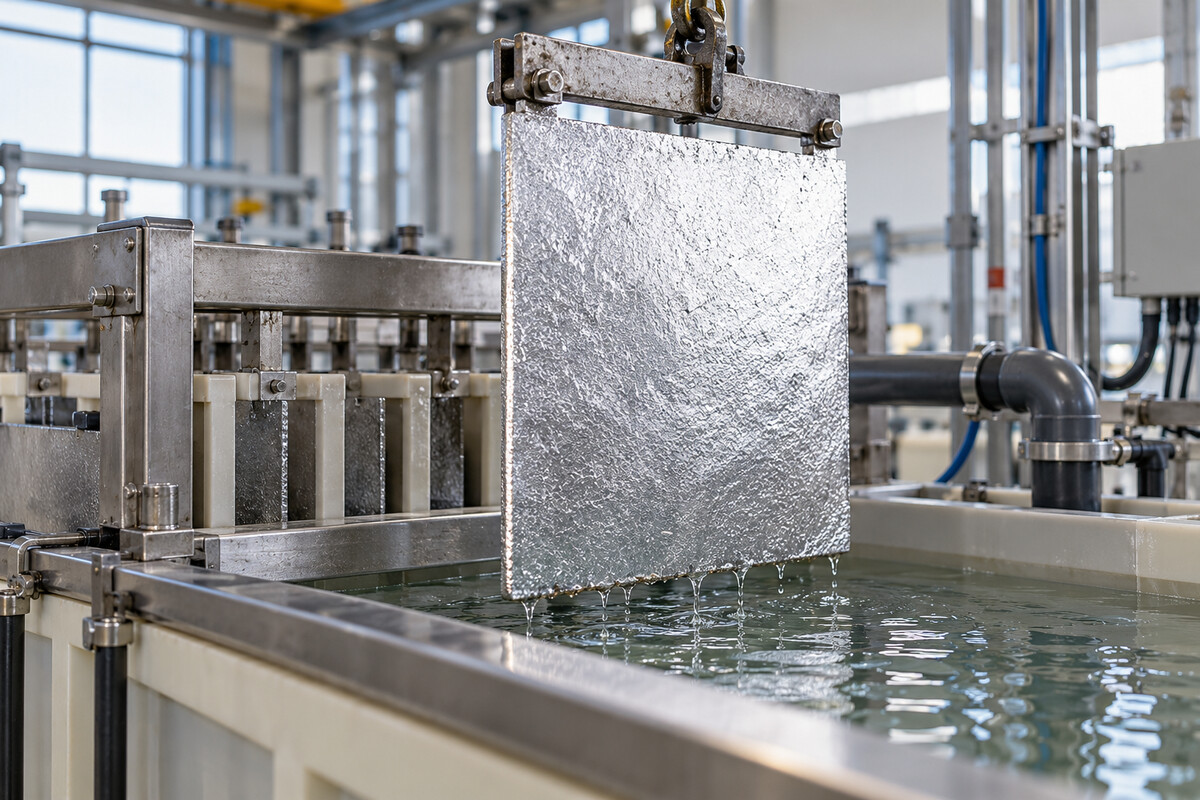
Electra unveiled a demonstration site in Jefferson County, Colorado, on Oct 21, 2025, with planned capacity of up to 500 metric tonnes of iron annually. The 130,000-square-foot facility was expected to begin operating in mid-2026. Its customers would qualify the material for steel applications. Nucor signed a purchase order for its electric arc furnace sheet mills. Toyota Tsusho America planned to sell qualified iron to steelmakers and distribute green steel to automakers; Interfer Edelstahl Group would pursue specialty-steel uses after qualification.
Meta separately contracted to purchase verified environmental attribute credits associated with reduced emissions from Electra’s iron, with an option covering future commercial facilities. Its supply-chain net-zero target was 2030. A $50 million Breakthrough Energy Catalyst grant supported the demonstration project. Physical iron orders, environmental credits and financial support accompanied the same scale-up programme.
The Boulder pilot and its iron plates
Electra commissioned its pilot in Boulder, in the United States, in March 2024. BHP, an investor as well as an iron-ore supplier, supplied ore for the plant. The pilot used already-mined material with high impurity levels that was commercially stranded under established processing methods. Its product was metallic iron intended for electric arc furnace steelmakers, where it could be combined with recycled steel scrap. The pilot was designed around plates approximately one metre square, with capacity additions planned in phases to validate the modular approach.

Electra’s development programme also covered materials separated from the ore. Alumina and silica, normally treated as iron-ore impurities, were potential coproducts. The company intended to recover value from these materials alongside iron production. Nucor’s then executive vice president of raw materials, Noah Hanners, anticipated that pure iron could help steelmakers use a broader range of scrap in higher-value steel products. That was an industrial customer’s view of the feedstock’s potential application, alongside the pilot’s work on iron production and modular expansion.
Dissolving ore and recovering iron
Electra’s electrochemical route operates at approximately 60°C. Ore dissolves in a water-based acidic solution, impurities are removed while iron remains dissolved, and electricity deposits iron metal from the solution. Electra describes a closed process that regenerates water and chemicals. Its technical description identifies three development problems: accelerating ore dissolution, separating impurities without losing the dissolved iron, and stabilising iron during electrowinning. Reactions that repeatedly change iron’s electronic state can otherwise reduce electrochemical efficiency and the amount of metal deposited.
Electra attributed its ability to stop and start quickly to low operating temperatures and low thermal mass, allowing production to use intermittent renewable electricity. The company’s April 2024 technical account also identified larger bespoke assemblies for existing electrowinning equipment as a scale-up risk. Its proposed approach involved experienced equipment suppliers and engineering, procurement and construction-management firms. Electra had made its first one-square-metre iron plate in December 2023, following its founding in May 2020. Larger installations and commercial adoption remained development objectives, distinct from those early plate-production milestones.

Ore quality and the available steelmaking routes
Steelmakers have several routes for reducing emissions, with different requirements for ore and energy. BHP’s head of steel decarbonisation, Dr Nigel Tame, identified blast-furnace improvements, direct reduced iron with an electric arc furnace, direct reduced iron with an electric smelting furnace, and electrolysis as four broad pathways in October 2024. Regional power supplies, reductant availability, plant age, raw-material quality and costs affect the options available to an individual producer. BHP was investing in electrolysis development through its venture business, including its investment in Electra.
Scrap-based electric arc furnaces can reduce dependence on newly refined iron, but the availability of scrap constrains how far that route can expand. Tame also identified ore suitability as a constraint for direct reduction, estimating that only a small share of seaborne ore then met established DRI-EAF specifications. BHP’s programme therefore covered both changes to existing production and technologies still moving from laboratory work into pilots. Electra occupied that emerging-technology part of the portfolio, with later demonstration work intended to take its process beyond pilot production.
Electric furnaces in the capacity pipeline
Electric arc furnace capacity expanded by nearly 11% between 2020 and the May 2025 assessment by Global Energy Monitor. EAFs accounted for half of steelmaking capacity under development, but less than one-third of that EAF pipeline was under construction. The distinction separates proposals from projects that had entered construction. GEM’s tracking covered more than 1,200 iron and steel plants and almost 900 iron-ore mines, connecting developments in steelmaking equipment with the supply of materials used to make iron.

Direct reduced iron represented 42% of ironmaking developments in that assessment, compared with 10% of operating ironmaking capacity. Under the announced pipeline, GEM projected that EAFs could reach 36% of the global steelmaking fleet by 2030, close to the IEA’s 37% benchmark. These figures describe capacity and development status rather than actual steel output. Electra’s proposed product would enter this industry as an iron input for electric furnaces. Its demonstration capacity was an ironmaking figure, while GEM’s EAF fleet figures concerned the equipment that subsequently makes steel.
Interfer’s earlier specialty-steel collaboration
Electra and Interfer signed a memorandum of understanding in December 2024 to collaborate on clean iron and green steel. Their work focused on using high-purity iron in specialty steel and supporting customers seeking lower-emission materials. Interfer’s business spans long and flat steel products, alloys and raw materials. Its customers operate in automotive manufacturing, construction, mechanical engineering and wind energy. The collaboration linked Electra’s developing iron process with a distributor serving several industrial uses, before the later demonstration-plant purchase commitments.
Interfer had its own target to cut absolute Scope 1, 2 and 3 greenhouse-gas emissions by 42% by 2030 against a 2022 baseline. That target concerned the distributor’s emissions, including those associated with its value chain. It was a corporate goal rather than a measured reduction from an Electra delivery. The memorandum established cooperation on prospective materials and applications. Subsequent qualification and purchasing arrangements belonged to later stages of the relationship, following the initial agreement to work together on iron and steel supply.

Testing the product before commercial expansion
Electra’s head of communications and policy, Kellyn Blossom, described a staged development programme in an October 2025 interview with Latitude Media. The demonstration phase would supply material to customers for testing and qualification before larger commercial operations. Product qualification was part of the planned sequence between producing iron at demonstration scale and supplying wider markets. Electra was also exploring uses for high-purity iron beyond conventional steelmaking, including magnets and lithium iron phosphate batteries.
Magnets and lithium iron phosphate batteries require concentrated, pure iron, a characteristic that attracted Electra’s interest in those markets. The company’s development programme therefore included possible applications beyond the steel customers preparing to receive demonstration material. Blossom identified these as potential uses rather than established commercial product lines. Qualification work and the progression from demonstration output to commercial scale remained part of the company’s plans.
Equity investors across the supply chain
Electra announced a $186 million Series B round on Apr 24, 2025, co-led by Capricorn Investment Group and Temasek Holdings. Financial participants included Breakthrough Energy Ventures, Builders Vision, Collaborative Fund, Earth Venture Capital, Lowercarbon Capital and S2G Investments. The round also included BHP Ventures, ore suppliers Rio Tinto and Roy Hill, electric arc furnace steelmakers Nucor and Yamato Kogyo, and trading businesses Interfer Edelstahl Group and Toyota Tsusho Corporation. The investor group consequently included organisations operating at several points between mining and finished-steel markets.
The funding was intended to support construction of a Colorado demonstration plant, with work starting later in 2025, and production of iron for partner testing and qualification. Electra’s longer-term objective was a first commercial plant by the end of the decade. Nucor’s Noah Hanners, then executive vice president for sheet products, linked the company’s interest to automakers seeking lower embedded emissions and Nucor’s investments in EAF sheetmaking. Breakthrough Energy Ventures participated in the equity round; the separate demonstration grant came from Breakthrough Energy Catalyst.
Colorado’s refundable industrial credit
Colorado awarded Electrasteel Inc., which operates as Electra, up to $7.99 million through the Colorado Industrial Tax Credit Offering in May 2025. The award supported the proposed Jefferson County project. Electra then employed more than 130 people. State officials anticipated that its technology could cut greenhouse-gas emissions associated with iron production by 30% or more. That assessment concerned the technology’s prospective reduction potential, rather than a published measurement of a commercial plant’s annual performance.
The Colorado Energy Office administered CITCO as an industrial-decarbonisation programme. Its funding framework provided up to $168 million in refundable tax credits through 2032 or until available credits were reserved. Selection considered emissions reductions, innovation, project readiness, benefits to communities and the ability to attract other funding. Projects near disproportionately impacted communities were among the programme’s priorities. The Electra award was therefore a state industrial incentive with a maximum amount, alongside the company’s private financing. The rounded $8 million figure used in company announcements referred to this credit.

From a reservation to a tax claim
CITCO’s general guidelines released on Oct 1, 2025, set out a sequence for programme applicants. A conditional reservation precedes a formal Tax Credit Agreement and its statement of work. Eligible expenditure and completion then support a request for a cost certificate, audited by an independent licensed certified public accountant. The Colorado Energy Office reviews the documentation before issuing a tax credit certificate. An awardee files that certificate with its state income-tax return; credit exceeding income tax owed is refundable.
A reservation alone does not entitle an applicant to a certificate. The October guidelines also require progress reporting before completion and continuing performance reports for qualifying projects after the credit is received. Records must be retained, and the state may inspect projects and supporting information. These were general rules for that application cycle, rather than disclosure of Electra’s individual agreement. They distinguish the stages of a refundable-credit programme: reserving support, completing eligible work, verifying costs and claiming the credit. The May award announcement did not establish that Electra had already completed every stage.
Contracts, attributes and emissions accounting
Low-emissions steel procurement involves definitions, measurement methods and the handling of environmental attributes through supply chains. The International Energy Agency’s assessment published on Oct 30, 2025, identified consistent chain-of-custody rules and transparent emissions accounting as priorities for the sector. Reporting and verification need to guard against double-counting reductions and establish additionality when materials and their attributes move through different arrangements. Different measurement systems also need sufficiently compatible methods for buyers to compare products across markets.

The IEA distinguished broad demand commitments from firm offtake and advance purchase agreements. In its assessment, firm agreements can give suppliers greater certainty for final investment decisions and help establish supply chains. More than 70 organisations had made commitments through initiatives including the First Movers Coalition, SteelZero and the Industrial Deep Decarbonisation Initiative. Buyer-supplier matching programmes signalled 3.3 million tonnes of demand in 2024. These were sector-wide developments, alongside the individual agreements being negotiated by producers. The IEA’s accounting recommendations were general principles for low-emissions materials, rather than certification of Electra’s credits or a finding about Meta’s contract.
Later financing for a commercial facility
Electra secured a $30 million venture debt facility from J.P. Morgan on Mar 10, 2026. The facility was intended for planning and preparation as Electra advanced towards its first commercial plant. Chief financial officer James Rutland associated the financing with bringing the company’s iron to market and meeting prospective demand. The arrangement was venture debt, distinct from the earlier equity round, the Catalyst grant and Colorado’s refundable tax incentive. The announcement concerned access to a financing facility for the next development stage.
Electra continued to base its expansion plans on modular electrowinning systems, drawing on methods used elsewhere in mining and metals. Its stated aims included phased capacity additions, lower initial capital requirements and a shorter route to market. J.P. Morgan Commercial Banking’s climate-technology team supported that commercialisation programme. The company still described a first commercial facility as an objective and commercial scale by the end of the decade as its target. The March financing announcement did not establish completed construction or an operating commercial plant.
POSCO joins the development programme
Electra and POSCO announced a joint development agreement on Apr 28, 2026, accompanied by an investment from POSCO Investment, the group’s corporate venture capital arm. Their programme would test and qualify technologies for commercial production of high-purity iron. POSCO’s technical contribution covered direct-reduction ironmaking and engineering, alongside Electra’s electrochemical process. The partners intended to test how POSCO’s decarbonisation developments could integrate with Electra’s system at commercial scale. They did not disclose the investment amount.
POSCO is headquartered in Pohang, South Korea, and has a decarbonisation roadmap extending to 2050, including development of hydrogen-based ironmaking through HyREX. POSCO Investment identifies deep-technology businesses as potential sources of growth for the group. Its participation added an investment relationship to the technical collaboration. The announced work covered:
- testing technology combinations for commercial-scale iron production;
- qualifying processes for high-purity iron used in high-grade steel;
- bringing steelmaking, process-development and engineering experience into the joint programme.
The agreement established a programme of cooperation and testing. Successful commercial integration remained the partners’ objective, with the development work still to be carried out.









Leave a comment