
The European Southern Observatory's Extremely Large Telescope (ELT) is being built on Cerro Armazones in Chile, with a planned primary mirror roughly 39 metres across. In January 2025, the €1.45 billion project was about 60% complete. Boxes containing mirror segments awaited installation in the Atacama Desert, approximately 3,050 metres above sea level and 1,000 kilometres north of Santiago.
ESO representative Itziar de Gregorio expected the telescope to examine early stars and galaxies and investigate exoplanet atmospheres for possible signs of life. Assembly, integration and verification manager Tobias Muller stressed the complexity of its multiple mirrors. The January 2025 construction milestone carried a forecast of first scientific observations by the end of 2028. The project was expected to become the world's largest optical-infrared facility and retain that position for decades.
Construction before the mirror installation
The ELT had passed the halfway mark in July 2023. ESO calculated progress using earned value, a project-management measure that incorporates schedule and cost. Its percentage therefore represented progress against the project plan. The first half included detailed design work for most components, together with prototypes and substantial testing of mirror segments, supports and sensors before series production could proceed. These activities formed part of construction progress alongside the visible steelwork taking shape on the mountain. By that milestone, all six thin M4 petals had been finished and were being integrated into their structural unit.

Workers had flattened Cerro Armazones's summit in 2014 to create space for the telescope. By July 2023, the technical building for storing and coating mirrors was erected and fitted out, while a photovoltaic plant supplying renewable electricity to the ELT site had begun operating the previous year. The pandemic had closed the construction site for several months and delayed component production. ESO expected the second half to proceed faster after production resumed, while acknowledging the remaining risks of finishing and operating such a complex facility.
Glass-ceramic blanks and a replacement inventory
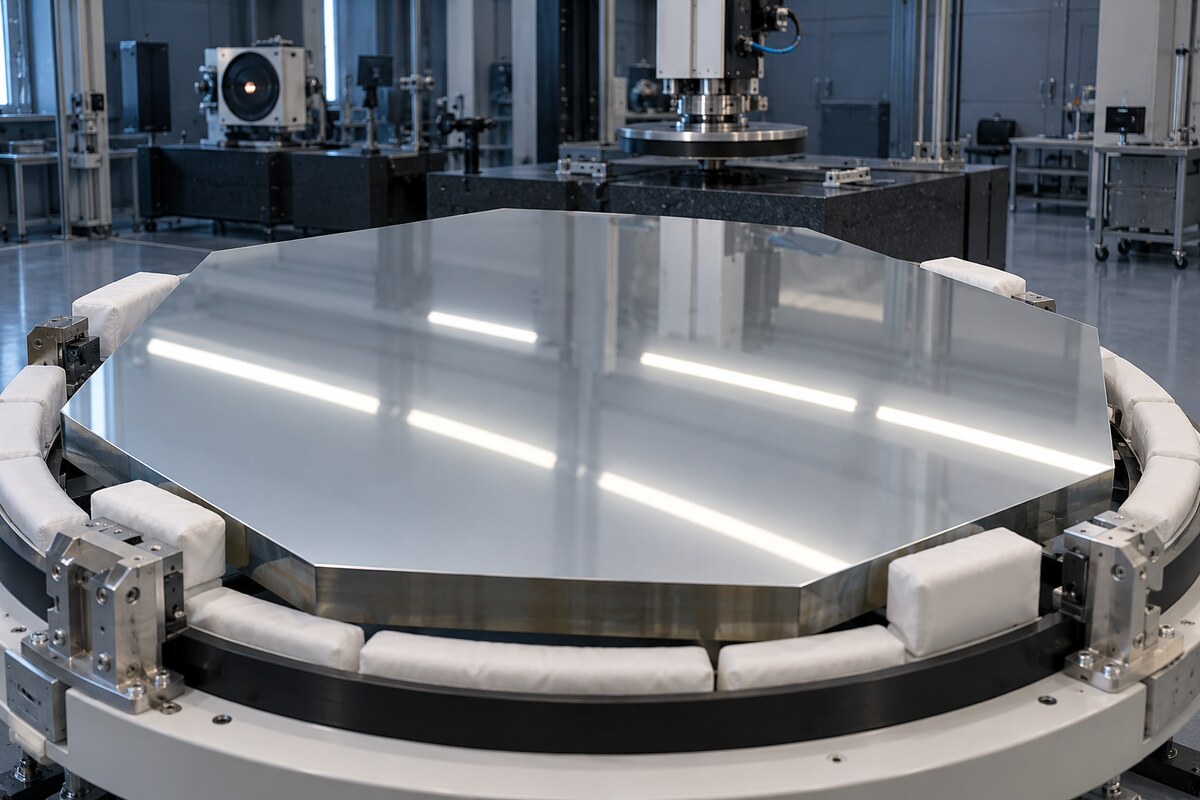
SCHOTT completed delivery of the last primary-mirror blank in June 2024. The order comprised 949 blanks: 798 for the working mirror, 133 to support exchanges during maintenance and recoating, and 18 spares. Each working segment is approximately 1.5 metres across and five centimetres thick. The exchange inventory allows segments to leave the telescope for surface maintenance; the full procurement total exceeds the number assembled into the observing surface.
The blanks use ZERODUR, SCHOTT's low-expansion glass-ceramic, adapted for the temperature conditions at the desert site. Casting is followed by controlled cooling and heat treatment. SCHOTT then shapes the surfaces by precision grinding before the blanks travel to Safran Reosc in France for hexagonal cutting and polishing. The specified optical-surface precision is 10 nanometres. SCHOTT manufactured more than 230 tonnes of material for the order and also supplied blanks for the ELT's second, third and fourth mirrors. VDL ETG Projects supplies the primary-segment supports. ESO and SCHOTT jointly refined the production steps to meet the telescope's requirements across the complete series.

Series production in an optics factory
Safran Reosc industrialised the polishing and assembly work at Poitiers. The company invested €30 million in modernising a dedicated 5,000-square-metre building, inaugurated in 2020. Its primary-mirror contract, awarded in 2017, encompasses optical polishing, mechatronic integration and testing. In October 2026, Safran expected production of its 931 segments to finish by that year's end. This total comprises the 798 observing segments and 133 exchange segments; it is distinct from SCHOTT's larger blank order, which includes additional spares.
The production line combines contactless ion-beam polishing, digital metrology and radio-frequency identification for traceability. Automation supports the repeated processing of a large series of demanding optical components. Safran's other site, at Saint-Pierre-du-Perray in Essonne, produces the telescope's four remaining mirrors. Safran Reosc president Aurélie Girou described the ELT work as a foundation for the company's ambitions in space optics, including satellite constellations and observation systems. Those future applications were company plans accompanying the October 2026 manufacturing update. Girou linked the programme's series-production capability to a decade of innovation and work by both sites.
The journey to Paranal and recurring coating
The first 18 finished segments reached ESO's Paranal Observatory on Jan 12, 2024. Their route began near Poitiers, continued by road to Le Havre, and crossed the ocean after departure on Dec 17, 2023. Antofagasta Terminal International received the shipment in Chile before the final overland stage to Paranal. The international movement covered approximately 10,000 kilometres. ESO engineers inspected the segments at their destination to establish whether transport had caused any damage.

At Paranal's ELT Technical Facility, the segments enter the coating stage that gives their optical surfaces a highly reflective finish. ESO planned to repeat this treatment on each segment every 18 months once observations begin. The logistics sequence connects optical finishing in Europe with inspection and coating in Chile:
- Move the finished segments to the French departure port.
- Ship them across the ocean and unload at Antofagasta.
- Transport them to Paranal for inspection.
- Apply the reflective coating before installation on the telescope.
Keeping hundreds of surfaces aligned
Each primary-mirror segment rests on three position actuators and carries sensors around its edges. ESO announced completion of the final batches in October 2024: approximately 4,500 pairs of edge sensors and about 2,400 actuators. The sensors measure relative displacement between neighbouring segments to a precision of a few nanometres. Position corrections then bring the separate surfaces into the smooth overall curvature required for the primary mirror to function as one optical element.
FAMES, a consortium established for the project by Germany's Micro-Epsilon Messtechnik and France's Fogale Nanotech, produced the edge sensors. Physik Instrumente designed and developed the actuators in Germany. These support the segment assemblies, whose mass is around 250 kilograms, and control movement in piston, tip and tilt. Their adjustments have precision on the scale of a couple of nanometres. After delivery to ESO, the sensors and actuators travel to Chile for integration with the mirror assemblies and telescope structure.

A separate mechanism for image stabilisation
The fifth mirror, M5, changes its pointing rapidly while remaining rigid. Its support cell reached provisional acceptance in September 2024 at Sener's facilities near Barcelona. Sener designed, built and tested the cell and supplies its controls and auxiliary equipment. Actuators from France's Cedrat Technologies move the mirror on a stiff supporting structure. Fast position sensors and a digital processor complete the control loop that determines and adjusts its position.
The mechanism is designed to steer the mirror as often as ten times per second, with angular accuracy within a few tens of milliarcseconds. Its small movements compensate for wind, atmospheric turbulence and disturbances from the telescope's own mechanisms. M5 does this without bending its surface. Working with the fourth mirror, M4, it forms part of the adaptive-optics system intended to stabilise the collected images. Acceptance of the cell was a mechanical and control-system milestone; the mirror itself still required optical processing before shipment to Chile. Mersen Boostec produced the mirror blank, which Safran Reosc was polishing at that time.

Laser guide stars and their component suppliers
The ELT's initial six laser guide stars will provide artificial reference points for measuring atmospheric distortion. Yellow-orange light excites sodium atoms high in the atmosphere, creating the reference spots. Adaptive mirrors use the resulting measurements to correct the blurring of astronomical light. The telescope can accommodate eight guide stars, leaving room for a later increase from the initial six. Each laser delivers 22 watts through a beam expanded to a diameter of 30 centimetres.
TOPTICA and Canada's MPB Communications completed nine laser sources by September 2024. Six were allocated to the ELT and three to GRAVITY+, the upgrade of ESO's Very Large Telescope Interferometer. ESO integrates the light sources with the other components of each guide-star unit. TNO in the Netherlands supplies projection subunits that expand the beams and direct them skyward, while Italy's Tecoelettra supplied heat exchangers to stabilise source temperatures. The work extended a programme begun in 2009 to develop and industrialise laser technology suitable for sodium guide stars. All nine light sources had been delivered to ESO when the production milestone was celebrated near Munich.
Flexible optics, vibration and air movement
M4 is a deformable mirror formed from six thin sectors, each only 1.95 millimetres thick. More than 5,000 voice-coil actuators and capacitive sensors control the assembly, with mirror-shape adjustments at a frequency of 1,000 times per second. A silicon-carbide reference body provides the supporting geometry. The system also uses high-speed distributed electronic control and active cooling. These are separate functions from M5's rigid tip-and-tilt motion: the optical train combines a surface that changes shape with a mirror that changes direction.

Vibration and thermal behaviour also receive explicit engineering analysis. Motors, mechanisms, fans and pumps are modelled as vibration sources, checked experimentally, and evaluated for their effect on observations. Active or passive dampers provide mitigation where required. Air movements produced by temperature differences inside the dome can introduce further disturbances. Computational fluid-dynamics simulations examine heat sources, structural cooling and ventilation arrangements, including louvers. The telescope's central controls must support steering and sophisticated real-time algorithms, requiring specialised software and high-performance computing hardware. The engineering team treated control correction as limited: vibration sources also required modelling and mitigation in the mechanical design.
Precision parts for the scientific instruments
Instrument production extends to Dwingeloo in the Netherlands. NOVA MAX, a manufacturing and assembly facility, received €18 million from the Dutch Research Council for a ten-year period. NOVA unites astronomy institutes at Amsterdam, Groningen, Leiden and Nijmegen. A computer-controlled milling machine at the facility can produce parts up to 1.3 metres across. Its size required space on an industrial estate beyond the group's existing instrumentation premises at ASTRON. Ramon Navarro, NOVA's head of optical infrared research and development, led the facility.
In October 2023, the machine was producing components for MICADO, a camera with 12,000 by 12,000 pixels. Large components reduce the number of connections that introduce small deviations during assembly. Optical components require nanometre-scale precision, while mechanical components require micrometre-scale precision. The production team was machining three large aluminium wheels from a stock of five high-grade blocks. NOVA also works with technical education providers to train instrument makers and technicians. Groningen astronomer Eline Tolstoy monitors the Dutch contribution against scientific specifications, while the international science team had pooled an allocation of 128 observing nights for its research plans.

Cryogenic mechanisms for METIS
METIS, an imager and spectrometer, requires rotary mechanisms that change its optical configuration at cryogenic temperatures. CEA's IRFU completed delivery of 14 ICAR mechanisms in February 2025, including two spares for the 12 operational units. Their specifications include operation at −230°C and positioning repeatability of ±0.001 degree. Design and prototyping occupied 2015–2021, followed by preparation, integration and testing of the small production series.
MEGEP manufactured mechanical components with tolerances sometimes as tight as five micrometres. Production involved resolving motor procurement, coil-resin quality and bearing problems. IRFU began procuring Safran D&S stepper motors early, while ASELEC helped address the electromagnetic coils' resin issues. IRFU assembled separately purchased bearing balls and cages after adapting standard bearings to the project's requirements. Temperature probes and home-position sensors were ordered together to maintain uniformity across the units.
A second cryostat enabled two mechanisms to undergo tests in parallel. The assembly procedure contained more than 100 steps, reorganised so technicians could work on two to four mechanisms concurrently. CEA reported compliant delivery after 24 months of assembly and testing. The cryogenic mechanisms then went to laboratories building METIS subassemblies in the Netherlands, Germany, Scotland and Taiwan.

A structure built to carry the optical system
By July 2026, the 3,500-tonne telescope structure had undergone its first rotation. Its horizontal primary-mirror cell will carry M1, while a central tower supports M3, M4 and M5. M2 will hang from the structure overhead. Scientific instruments occupy platforms on the sides.
ESO expected the fully equipped structure to weigh approximately 4,600 tonnes after installation of the mirrors and instruments. The two mass figures describe different stages of completion. The rotation test checked a mechanical requirement for pointing the telescope across the southern sky; it preceded operation of the completed observing system.

Revised milestones and instrument integration
ESO's December 2025 programme assessment revised the earlier timetable. Telescope first light was planned for March 2029 and first scientific observations for December 2030. A risk analysis had led to the delays. The cost to complete, including telescope and construction instruments, increased by almost €90 million. ESO planned to absorb the additional construction cost within its long-term finances, with a tighter budget over the following years. Additional instrument costs included greater technical support from ESO and contingency.
The same assessment placed MICADO and METIS in manufacturing, assembly, integration and testing. MORFEO was approaching a final design review in 2026. ESO and the HARMONI consortium had developed a revised instrument concept for scientific and technical review. The two pre-focal stations were undergoing factory tests, and the phasing and diagnostic station was being integrated at ESO. Dome cladding was almost complete, its sliding doors could close, and heating, ventilation and air-conditioning equipment was being installed. These dated integration milestones distinguish component production from the future delivery of scientific observations.


















Leave a comment