
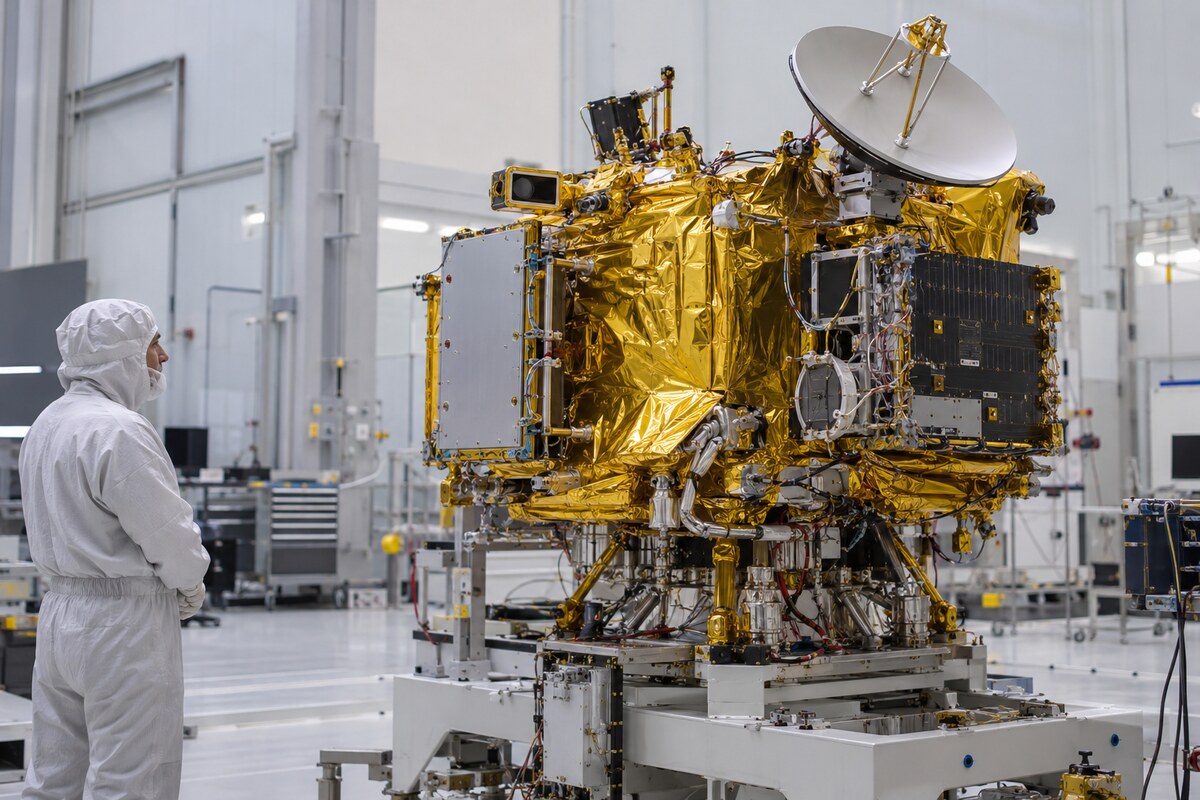
Europa Clipper left Florida on October 14, 2024, beginning a journey that links a large scientific programme with years of spacecraft manufacturing, assembly and operations. The robotic probe launched from Kennedy Space Center in the United States on a SpaceX Falcon Heavy rocket. Its destination is the Jupiter system, where repeated encounters with the icy moon Europa are intended to examine whether an ocean beneath the surface could provide conditions suitable for life. The investigation concerns habitability. It is not equipped to announce the discovery of organisms simply by arriving at the moon.
The spacecraft’s engineering reflects that distinction. Cameras, spectrometers, radar, magnetic measurements and radio observations will collect different kinds of evidence about the same environment. Europa is approximately 3,100 kilometres across and orbits about 671,000 kilometres from Jupiter. Estimates place its ice shell at roughly 15–25 kilometres thick and its underlying ocean at about 60–150 kilometres deep. Those are scientific estimates to investigate, rather than measurements already established by the new spacecraft. The scale of the suspected ocean, the moon’s chemistry and the possible availability of energy explain why the mission combines several observing methods instead of depending on one detector.
A launch within a much longer programme
The Falcon Heavy lifted off at 12:06 p.m. EDT from Launch Complex 39A. Approximately an hour later, Europa Clipper separated from the rocket. Two-way communication was established at 1:13 p.m. through NASA’s Deep Space Network station in Canberra, Australia. Initial telemetry indicated that the spacecraft was operating as expected. These were completed launch-day events, distinct from the scientific encounters planned for the following decade. Europa Clipper’s departure opened a cruise phase during which teams would continue checking systems, deploying hardware and preparing for the Jupiter tour.

NASA’s mission plan places Jupiter arrival in April 2030, with science-dedicated Europa flybys beginning in early 2031 and the prime scientific programme extending into 2034. The agency’s approximately $5.2 billion lifecycle investment covers a programme stretching from formal initiation in 2015 through the prime mission. That figure encompasses a much longer undertaking than the launch operation alone. Development, spacecraft systems, scientific payloads and the subsequent mission all belong within that time horizon. The spacecraft was built to conduct a little over four years of prime operations after reaching Jupiter; the intervening journey is an additional period of navigation, testing and preparation.
Hardware assembled across several locations
NASA’s Jet Propulsion Laboratory in Southern California leads the mission’s development in partnership with the Johns Hopkins Applied Physics Laboratory in Laurel, Maryland. The main spacecraft body was designed by APL in collaboration with JPL and NASA’s Goddard Space Flight Center in Greenbelt, Maryland. Programme management sits with the Planetary Missions Program Office at Marshall Space Flight Center in Huntsville, Alabama. Kennedy’s Launch Services Program manages the launch service. These responsibilities cover different parts of the project: development leadership, the spacecraft’s central structure, programme oversight and the launch interface are connected tasks with separately identified organisations.
The distributed work continued through component delivery and final preparations. The solar arrays arrived at Kennedy on February 21, 2024, after assembly by Airbus workers in Leiden in the Netherlands. Air transport brought the arrays to Florida, followed by a truck journey from Miami to Kennedy. Engineers at JPL had integrated instruments, the electronics vault and other key systems with the spacecraft body. Kennedy then provided the setting for further installation and launch preparation. More than 4,000 people had contributed to the mission after its formal approval, including personnel working for contractors and subcontractors.

Compact for launch, expansive in operation
Europa Clipper has two very different physical configurations. Its central spacecraft body is about 3 metres wide, 4.7 metres tall and 4 metres deep. With its solar arrays deployed, the span exceeds 30.5 metres. Radar antennas extending in association with the arrays give the deployed spacecraft a dimension of approximately 17.6 metres in the other direction. An 8.5-metre boom supports the magnetometer sensors. At launch it weighed around six tonnes, including approximately 2,750 kilograms of propellant. These figures describe different components and directions, so the body’s dimensions should not be confused with the area occupied by the fully extended spacecraft. Large deployable elements allow the flight configuration to differ substantially from the compact launch arrangement.
Solar power at a distant planet
Each of Europa Clipper’s two solar arrays contains five panels and measures approximately 14.2 metres by 4.1 metres. Together, they provide about 102 square metres of collection area. Jupiter is more than five times farther from the Sun than Earth, with sunlight there only around 4% of the level near Earth. The large collection area therefore belongs to the mission’s operating requirements, rather than being an incidental feature of its silhouette. The electrical system must power scientific instruments, computers, heaters and other spacecraft subsystems far from the stronger sunlight available during the early part of the flight.
The power specification also accounts for the radiation environment and the duration of the mission. The arrays were designed to provide at least 700 watts throughout prime operations at Jupiter, while their expected output shortly after deployment closer to the Sun was around 23,000 watts. Those figures apply to different conditions and are not an efficiency comparison at one location. Deployment itself was an important preparation step: the folded arrays had to travel with the spacecraft for launch and then open in space. NASA’s technical mission information describes power, protection and observing systems as parts of the same spacecraft design.

Electronics protection and component testing
Europa’s proximity to Jupiter places it in an intense radiation environment. Europa Clipper consequently combines a protected electronics vault with a flight plan that limits time near the moon. Sheets of aluminium-zinc alloy up to 9.2 millimetres thick form the vault’s walls. Inside are radiation-sensitive systems associated with instrument control, guidance and other functions. A radiation monitor uses sensors to track exposure and the performance of instruments and engineering subsystems. Shielding does not remove the environment outside the spacecraft; the monitor provides information for assessing what that environment is doing to the equipment during the mission.
Component qualification remained important during the final preparation period. In an August 28, 2024 update, NASA said extensive testing and analysis had been carried out on transistors that control electrical flows in the spacecraft. The analysis suggested that those components could support the baseline mission. The agency identified September 9 as the next major decision point for proceeding towards launch and operations. That update was a statement about testing and readiness before departure, not a claim that the hardware had already experienced years of conditions at Jupiter. Launch in October subsequently recorded the beginning of the flight rather than completion of that long-duration operating test.
Propulsion and temperature control
The propulsion module is built around an aluminium cylinder approximately 3 metres tall and 1.5 metres wide. Its tanks accommodate the spacecraft’s propellant, while 24 engines provide manoeuvring capability. Each engine can generate 27.5 newtons of thrust, and up to eight can operate together for a maximum of 220 newtons. This arrangement supports changes in the spacecraft’s motion and orientation during the mission. Large planetary gravity assists contribute to the trajectory, but the flight plan also requires powered corrections and the eventual manoeuvre into Jupiter orbit. Propellant, engines and navigation are therefore parts of a continuing operational system.

Temperature management must accommodate both the inner solar system and the much colder conditions farther out. Some components can exceed 100°C during the warm part of the cruise, while the outer environment can expose parts of the spacecraft to temperatures as low as about −230°C. Certain instrument detectors need temperatures below about −190°C for their work. Fluid loops move heat between locations, and the spacecraft also uses heaters, sensors, thermal blankets and a radiator. During a close encounter, simultaneous instrument activity creates another thermal condition to manage. The design must redistribute and release heat as well as conserve it, depending on which equipment is operating and where the spacecraft is flying.
A communications system with several roles
Technicians installed the high-gain antenna at Kennedy on June 17, 2024. Its dish is approximately 3 metres wide, and its design involved APL and Applied Aerospace Structures Corporation in Stockton, California. The antenna provides the principal link for sending scientific data and receiving commands across interplanetary distances. Seven smaller antennas provide other communication paths and support radio investigations. Different antenna orientations matter because the spacecraft cannot always point its large dish at Earth while carrying out other activities. Hardware placement and the observing schedule therefore affect when and how the spacecraft communicates with the ground.
The communications equipment works through NASA’s Deep Space Network, which uses geographically separated ground stations to communicate with distant missions. The antenna installation update identified X-band frequencies of 7.2 and 8.4 GHz and Ka-band operation at 32 GHz. It also described a signal travel time of around 45 minutes when Europa Clipper is operating at Jupiter. The figure is a mission communication estimate, rather than an instantaneous control link. Radio signals have a second scientific purpose: analysis of frequency shifts can reveal changes in spacecraft motion, helping investigators study Europa’s gravitational field and internal structure.

An instrument suite built for combined observations
Europa Clipper carries nine dedicated science instruments, alongside the gravity and radio science investigation that uses its communications system. The observing programme includes several complementary groups:
- Visible-light cameras and thermal imaging for surface features and temperature differences.
- Ultraviolet and infrared spectrometry for atmospheric and surface composition.
- Magnetic-field and plasma measurements for studying the environment around Europa and its suspected ocean.
- Ice-penetrating radar for the shell, plus gas and dust analysis of material encountered near the moon.
The Europa Imaging System combines narrow- and wide-angle cameras. Its planned mapping covers about 90% of the surface at better than 100 metres per pixel. The thermal imager looks for relatively warm regions, while the ultraviolet spectrograph examines atmospheric gases and possible plume activity. The infrared mapping spectrometer investigates the distribution of ices, salts and organic compounds. These instruments supply different measurements: a warm area, an unusual surface material and a geological feature are related observations, but none is interchangeable with another. Combining them is intended to give scientists a fuller basis for interpreting the moon’s surface and its connections with the interior.
Integration before interpretation
NASA’s January 30, 2024 instrument-integration update recorded that the scientific instruments had been added to the spacecraft at JPL. At that stage, the radar electronics were aboard, with the radar antennas still scheduled for installation on the solar arrays at Kennedy. The distinction between electronics and deployed antenna hardware is important when describing assembly progress. An instrument could reach one integration milestone while another part of its flight configuration remained to be completed elsewhere. With instruments and the telecommunications equipment installed, the team began testing the complete spacecraft as a connected system before shipment for launch preparations.

The instruments were planned to gather observations together during close passes. For example, the magnetometer measures the magnetic environment, while the plasma instrument helps investigators distinguish the contribution of charged particles around Europa. The mass spectrometer examines atmospheric gases, and the dust analyser studies particles encountered along the flight path. Those particles may come from Europa or from elsewhere in the Jupiter system, a distinction the measurements are intended to investigate. Simultaneous observations let researchers compare the circumstances in which different data were collected. They do not make every possible plume, subsurface feature or chemical ingredient a confirmed discovery before the measurements are obtained.
A tour designed around limited exposure
The journey to Jupiter covers approximately 2.9 billion kilometres and uses encounters with Mars and Earth to alter the spacecraft’s speed and direction. The prelaunch plan scheduled a Mars gravity assist in early 2025 and an Earth encounter in December 2026, followed by Jupiter arrival in April 2030. Near arrival, a Ganymede flyby helps slow the spacecraft before a long engine burn establishes Jupiter orbit. During the cruise, teams also test instruments, deploy components, update software and refine the tour. These activities make the transfer an operating phase of the programme, with work extending beyond simply waiting for the spacecraft to reach its destination.
The planned Jupiter tour includes 49 science-dedicated flybys of Europa, with encounters reaching as close as about 25 kilometres above the surface. The spacecraft orbits Jupiter rather than remaining in orbit around Europa, reducing prolonged exposure near the moon. Ganymede and Callisto encounters also help shape the trajectory. Across those passes, the mission’s central objectives remain the ice shell and ocean, the composition of materials, and the geology of the surface. The $5.2 billion programme, its distributed engineering teams and its combined instruments are directed towards those measurements. Whether particular regions offer habitable conditions remains a scientific question for the observations, not an outcome guaranteed by the spacecraft’s departure.


















Leave a comment