
A first beam before a finished light source
The Hefei Advanced Light Facility generated and delivered its first linear-accelerator electron beam on Sep 20, 2026. HALF is being built in Hefei, Anhui, as a fourth-generation synchrotron facility with a designed electron energy of 2.2 gigaelectronvolts. Its intended research spans materials, life sciences and energy. The injector milestone precedes the work of commissioning the storage ring and the complete facility.
Injector chief engineer He Zhigang said beam quality, stability and reliability would influence the ring and downstream experiments. He identified injection into the storage ring as the next commissioning stage. The project’s expectation of soft X-rays with over 100 times the brightness and coherence of third-generation sources remains a forecast. So do its ambitions for superconductivity, batteries, aerospace and biomedical research, and access for scientists from China and abroad.
The ring’s repeating magnetic structure
HALF’s accelerator arrangement combines a full-energy linear accelerator, a transfer line and a storage ring. In the 2023 physics design developed by Zhenghe Bai and colleagues, that ring had a circumference of 479.86 metres and twenty repeating cells. Each cell included a long straight section of 5.3 metres and a shorter middle straight of 2.2 metres. These spaces were intended to accommodate insertion devices, giving the project more locations for producing light for experimental beamlines.

The chosen magnetic lattice was a modified hybrid six-bend achromat, incorporating longitudinal-gradient bends and reverse bends. The baseline natural emittance was 85.8 picometre-radians, below the design requirement of 100. This is a beam-design parameter, not a result measured during September’s first-beam event. The design team also added thin sextupoles to control how oscillation frequencies change with amplitude. Their work addressed the acceptance needed to inject particles away from the centre of the circulating beam while maintaining room for small-gap insertion devices.
Short magnets with adjustable fields
The 2023 magnet design by T. H. Sun and colleagues envisaged about 680 magnets. Their compact arrangement created practical constraints: a magnet’s short length relative to its aperture makes fringe-field effects more significant, potentially introducing unwanted magnetic components. The design therefore combined pole-shape optimisation with attention to three-dimensional effects. Quadrupole cores used silicon-steel laminations, while correction windings supplied additional horizontal, vertical or skew fields within an already crowded layout.
Longitudinal-gradient dipoles used electromagnets with precisely varied gaps rather than the permanent-magnet approach considered earlier. Adjustable fields were required to accommodate potential increases in ring energy. Combined dipole-quadrupole magnets used an offset quadrupole geometry to provide bending and focusing. The team used NSGAII optimisation, conformal mapping and OPERA-2d calculations in developing pole profiles. In that 2023 study, physical and mechanical designs were complete, but the DL2 prototype was still being built. Its manufacture and magnetic measurements were intended to test the calculated performance, rather than merely repeat the design assumptions.

An injection system within one straight section
A separate 2023 study by Gangwen Liu and colleagues designed injection around three pulsed kickers, with one functioning as an anti-septum. Its approximately one-millimetre blade reduced the required separation between the incoming and stored beams. The arrangement fitted two septums and three kickers into a 5.3-metre straight section. In the model, the injected beam reached the ring at an off-axis distance of 3.8 millimetres. The anti-septum deflected the stored beam while leaving the injected beam unaffected by that particular kicker.
The proposed operating methods differed by stage. Initial ring commissioning would use on-axis injection of a single bunch; normal operation would use the complete bump system. Tracking simulations indicated injection efficiency could reach 99% with bump errors held to 100 micrometres and 100 microradians. The simulated stored beam recovered its orbit and emittance in about 80 milliseconds. These were conditional calculations. Septum and kicker prototypes were still under manufacture, and subsequent work was to incorporate their measured magnetic fields.
Correcting a ring that differs from its model
Positioning errors and imperfect fields can distort the orbit and change the ring’s optical properties. Penghui Yang’s team investigated these effects in a 2023 static-error study, assigning random errors to model lattices and applying corrections. Quadrupole misalignment was a principal source of orbit distortion. The correction sequence progressed from getting particles around their initial trajectory to correcting the closed orbit, restoring optical functions, and reducing vertical dispersion and transverse coupling. Those are related tasks, but each addresses a different departure from the intended motion.

Across one hundred simulated error sets, corrected closed-orbit distortions were below 60 micrometres in root-mean-square terms. The model’s beta-beating fell below 1.1%, and error-induced natural-emittance growth was generally below 3%. The optics correction used 320 independently powered normal quadrupoles and the LOCO method; another eighty skew quadrupoles addressed coupling and vertical dispersion. These results established performance within the study’s assumed errors and correction scheme. They did not establish the installed ring’s alignment accuracy or certify its eventual operational beam quality.
Rehearsing the commissioning sequence
Kemin Chen and colleagues extended the commissioning work in 2024 with start-to-end simulations using Accelerator Toolbox and the Simulated Commissioning toolkit. Their model included magnet misalignments, field errors, radiofrequency errors, beam-position-monitor errors and imperfections in the injected beam. The simulated machine could initially lack a closed orbit altogether. Correction first established initial transmission, then multiple turns, before increasing sextupole strengths. This ramp was needed to correct the large negative chromaticities associated with the strong-focusing lattice.
Radiofrequency phase and frequency corrections followed, using readings from successive turns. Beam-based alignment identified a reference orbit through quadrupole centres, and LOCO restored the optical functions. In the simulated sequence, particles survived more than five hundred turns after sextupole ramping and more than one thousand after RF correction. The authors planned further studies with many random error sets to assess statistical outcomes. The staged procedure is a computational rehearsal for commissioning; its turn counts are neither a September 2026 operating record nor evidence that all ring commissioning had finished.

Sharing a stable radiofrequency reference
Timing extends beyond an individual accelerating cavity. Kunlin Wu and colleagues developed a reference-distribution scheme with master oscillators at 499.8 megahertz for the ring and 2,856 megahertz for the linear accelerator. A 100-megahertz signal phase-locked the two sources. The design distributed references to RF equipment, beam-position monitoring, timing systems and beamline stations. Along the approximately 180-metre linac reference line, amplifiers were needed so that successive RF stations would still receive signals above the required power level.
Temperature control was part of that engineering. Coaxial cables and directional couplers were placed in a bath controlled to within ±0.1°C. Comparative cable tests covered 18–45°C; the team selected Andrew LDF2-50 cable and a bath temperature of 42°C, matching the accelerating tubes’ cooling water. Developed amplifiers added less than one femtosecond of phase noise over the stated 10-hertz-to-10-megahertz integration band. The estimated received-signal figure was below thirty femtoseconds. The amplifier result concerned added noise; the terminal figure was an estimate.
Keeping insertion-device changes from moving the beam
Changing an insertion device’s gap can change the electron beam’s emittance as well as the light delivered to an experiment. Xiaoyu Liu’s team compared mitigation methods in work published in March 2026. One option introduced controlled dispersion into long straight sections. Although values of twenty to twenty-five millimetres reduced emittance variation in their analysis, the resulting deterioration in nonlinear dynamics made that option unsuitable for HALF’s configuration. Another option used two long damping wigglers as compensation devices, requiring their gaps to move synchronously.

The researchers favoured a short compensation wiggler in a dispersive middle straight section near the injection area, where space constraints prevented a user beamline. Their model used a 1.5-metre device with a 100-millimetre period. With the two long damping-wiggler gaps closed, the calculation produced a compensated emittance of 72 picometre-radians for short-wiggler fields of 0.67–1.45 tesla. This was a comparative design result, with advantages including reduced mechanical attraction and energy-spread variation. It was not a statement that the proposed device had been installed or had achieved those values in operation.
Testing a possible triple-cavity system
Bunch-lengthening research addressed another source of beam behaviour. Jincheng Xiao, Tianlong He and Weimin Li extended the GPU-accelerated STABLE code to study an assumed triple-RF arrangement for HALF, combining the main cavity with third- and fifth-harmonic cavities. Their simulations represented each bunch with ten thousand macroparticles and tracked three hundred thousand turns. A fifty-milliampere benchmark compared the tracking results with a semi-analytical calculation. The methods agreed on the equilibrium bunch-centre and bunch-length distributions under the test conditions.
At 350 milliamperes, however, the joint beam-loading effects of the two harmonic cavities intensified periodic transient beam loading in the simulated cases. Adding the higher harmonic did not automatically damp the instability. Another configuration, using a passive fifth-harmonic cavity, produced an unexpected equilibrium with little bunch stretching; active voltage control suppressed that behaviour under the same target voltage. The authors identified further work on feedback, feedforward and higher-order cavity modes. Published in March 2026, the study concerns possible RF configurations and their limitations, rather than a description of three cavities already running at HALF.

Delivering coherent light to experiments
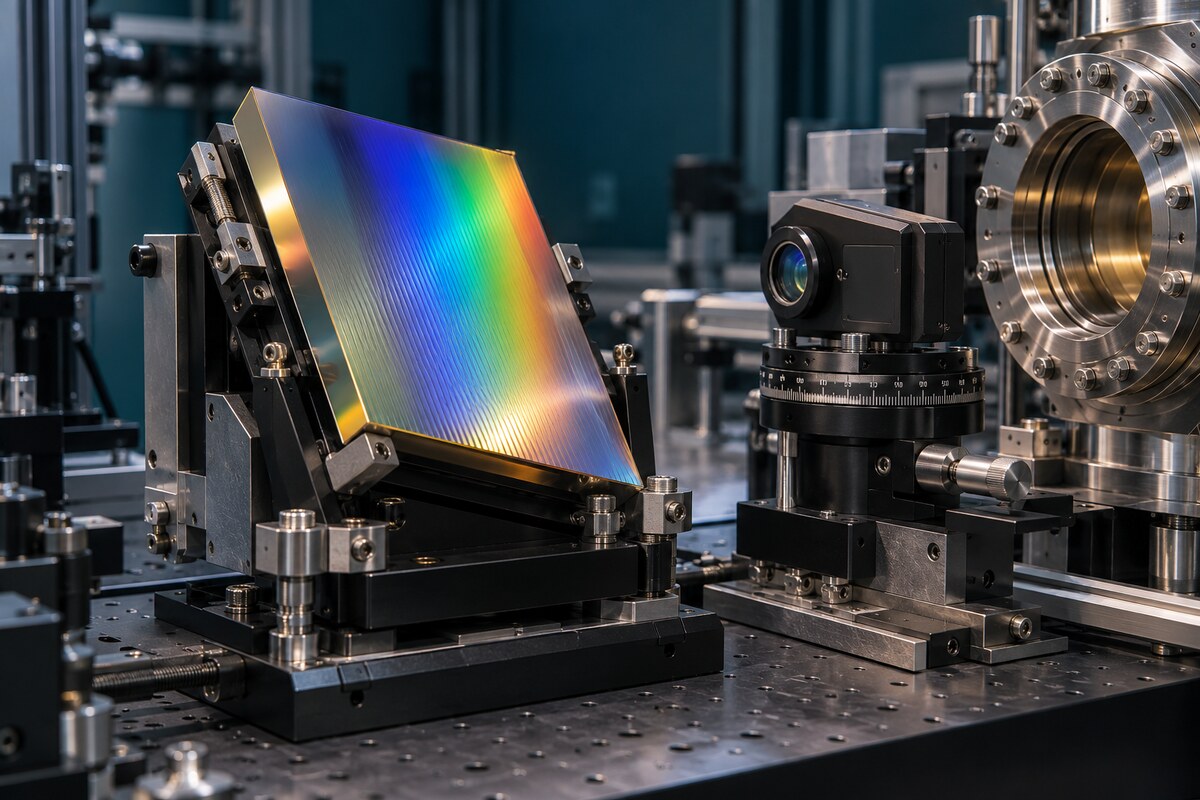
Xuewei Du’s November 2023 beamline presentation connected accelerator performance with experiments. Its initial ten-beamline plan spanned vacuum ultraviolet, soft X-rays and the higher-energy range commonly called tender X-rays. Planned methods included mass spectrometry, electronic-structure measurements, spectroscopy, scattering, spectromicroscopy and ptychography. Producing coherent radiation was only part of the task: mirrors, gratings and their supports also had to preserve suitable wavefront quality and stability. The presentation separated optical metrology, precision mechanisms and cooling as related engineering areas requiring their own development.
A proposed portable diagnostic combined spatial-coherence and wavefront measurements, using tools such as double slits, a Talbot interferometer and a Shack–Hartmann sensor. Mirror metrology included a completed long-trace-profiler system. Cooling studies examined both water and liquid-nitrogen approaches, while mechanical tests considered grating-angle stability and vibration under different water flows. These are examples from the 2023 development programme, not performance specifications measured at every completed beamline. The 2023 schedule anticipated trial users in May 2028 and project completion that October; both were future milestones.
An archive for accelerator operating data
HALF’s control-system plans also required a historical data archive. Xiaokang Sun, DaDi Zhang and Huhang Chen estimated about 250,000 EPICS process variables across the facility, with roughly ten percent selected for archiving. Their 2023 study envisaged 25,000 archived variables updating at an average of one hertz. Recorded fields included variable identity, timestamps, values, severity and status. The anticipated pattern was data written once and queried repeatedly, making retrieval performance an important criterion alongside the ability to keep up with incoming measurements.

The team built an eight-virtual-machine test platform to compare five databases and EPICS Archiver Appliance. In that specific single-threaded benchmark, TimescaleDB reached about 1.4 million retrieved items per second and about 120,000 inserted items per second. These rates belonged to the tested hardware, versions and workloads. They were not a universal database ranking or HALF’s production throughput. The researchers proposed a distributed TimescaleDB cluster and an archive prototype as subsequent work. Their paper therefore documents technology selection and testing before deployment, while preserving the distinction between an experimental benchmark and a running facility archive.
Reviewing the accelerator, beamlines and civil works
A joint machine and scientific advisory meeting in Hefei on Dec 5–8, 2025 brought together twenty-four experts. Gabriel Aeppli chaired the scientific committee and Amor Nadji the machine committee. HALF director-general Donglai Feng introduced the project; Guangyao Feng covered accelerator systems, Xiaosong Liu beamlines and end-stations, and Yang Pan civil works and utilities. Thirty-four system leaders took part in six parallel technical sessions. The review also included visits to the construction site, a prototype storage-ring cell, magnet-alignment tests and the existing Hefei Light Source.
Four planning areas
- Possible additional beamlines in the first phase.
- Priorities for a second phase of beamlines.
- AI-assisted acquisition of scientific data.
- Ways to work with industrial users.
NSRL’s December account described civil construction as approaching completion and handover, with hardware development continuing. Donglai Feng committed the project to implementing the committees’ recommendations, and annual meetings were planned in support of a 2028 completion and commissioning goal. That review supplied an organisational checkpoint, rather than a guarantee that subsequent technical milestones would be achieved.

A changed proposal enters environmental review
A Mar 19, 2026 public notice located the project in Gangji, Changfeng County, and described a sixty-four-month construction period. Unlike the earlier ten-beamline plan, this notice proposed twelve initial beamline stations, within capacity for at least thirty-five. Its injector and ring were each specified at 2.2 gigaelectronvolts. The notice also dated approval of the feasibility study to Jul 13, 2022 and the earlier environmental-impact approval to February 2023. These separate dates concern different stages of project authorisation.
As design information became more detailed, requirements changed for radiation-related openings and embedded conduits in the main ring building, and for beamline-hutch dimensions and shielding. USTC commissioned a revised environmental assessment because the changes required resubmission. The notice began a public-consultation process, with comments invited for ten working days; it was not itself approval of the changed scheme. The proposed increase in initial beamlines therefore belongs to a dated review document, while September’s reported achievement remained the injector’s first beam. Neither establishes that twelve experimental stations were already open to users.

















Leave a comment