
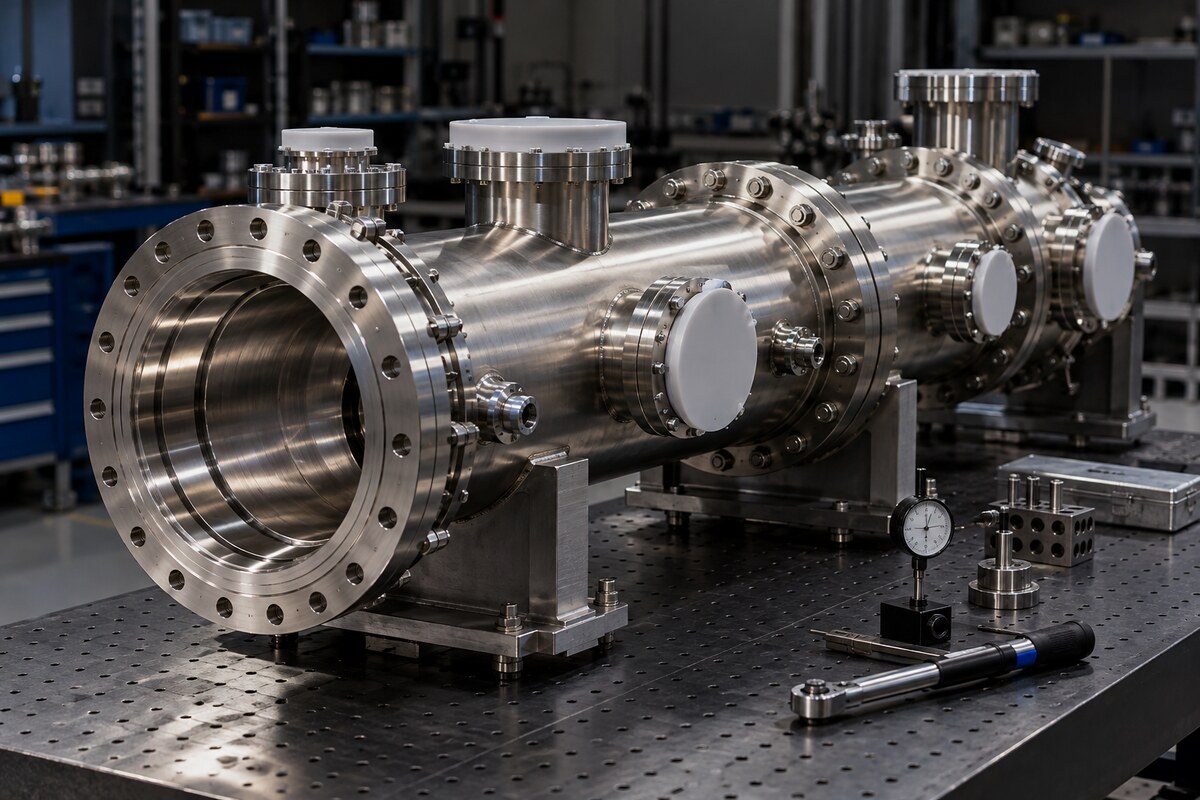
The High Energy Photon Source, HEPS, brings accelerators, beamlines, experimental stations and support facilities together in Beijing's suburban Huairou District. By July 2025, all 15 first-phase beamlines had generated light. The project team was targeting trial operations before the end of that year at the facility developed by the Institute of High Energy Physics, IHEP, of the Chinese Academy of Sciences.
Project director Pan Weimin envisaged further beamline construction with research institutes and industry. The July programme aimed for 45 beamlines by 2030, within an eventual capacity of up to 90. Those plans extended the experimental infrastructure beyond the first phase of China's high-energy fourth-generation synchrotron source.
Three accelerators with different jobs
The HEPS accelerator complex comprises a linear accelerator, a booster and a storage ring. The injector stages bring electrons from 500 megaelectron volts to 6 gigaelectron volts. The storage ring then holds high-energy, high-quality electron beams and supplies synchrotron X-rays for experiments. The ring is the core of the light source, while the linac and booster prepare its electron supply.

The storage ring was physically linked up in 2024. By July 2, the linac and booster had already passed their scientific and technical performance acceptance reviews, and the next storage-ring work involved inter-system commissioning followed by beam commissioning. The construction milestone concerned the connection of the accelerator components; the subsequent commissioning programme involved operating them together. HEPS was intended to support advanced-materials, aerospace and biomedical research through the penetrating, bright X-rays produced by the completed installation.
The first electron beam
The linear accelerator accelerated its first electron beam on March 14, 2023. Approximately 49 metres long, this first-stage accelerator can generate electrons and accelerate them to 500 MeV. IHEP built it as part of the larger HEPS scientific infrastructure project, establishing the first working stage of an accelerator complex whose other principal components were the booster and storage ring.
The intended experimental radiation was synchrotron X-ray light, with high brightness and strong penetration for examining microscopic structures. Advanced materials, aerospace and biomedicine were among the fields the project was designed to serve. At the March milestone, the immediate technical achievement was acceleration of the first beam in the linac; the remaining accelerator construction and commissioning stages still lay ahead.

Testing the injector
The linac underwent a separate performance test on May 18, 2023. During on-site testing, its macro-pulse charge reached 7.29 nanocoulombs and its beam-energy stability was 0.014%. Experts from other institutes and universities conducted the test, and a detailed testing outline and results were submitted to the acceptance committee. Scientific and technical performance acceptance followed on June 5.
The committee comprised 18 accelerator specialists: eight academicians and ten professors. Its work covered the linac's performance and suggestions for further improvement before commissioning the booster and storage ring. The engineering programme included high-level beam-commissioning software, cathode-grid assemblies, solid-state modulators based on insulated-gate bipolar transistors, and high-gradient accelerating structures. These were components and tools developed within the linac programme. The National Development and Reform Commission approved HEPS, and IHEP began construction in June 2019 with a planned construction period of six and a half years. The May test and June acceptance represented additional stages after the first electron acceleration in March.
Vacuum connections around the booster
At the beginning of 2023, connection of the last shielded bellows completed the booster installation. Its approximately 454-metre perimeter accommodates the second accelerator stage and the charge-accumulation functions needed for injection into the storage ring. The arc contained 132 pre-alignment units combining magnets, vacuum equipment and beam-measurement equipment, while the straight sections housed injection and extraction equipment, radio-frequency equipment and further diagnostics.

The booster vacuum system used a thin-walled, water-cooled chamber to address heat deposition and eddy-current effects. Shielded bellows and shielded gaskets controlled the impedance associated with vacuum components. Installation included vacuum sealing and leak detection around the booster tunnel. Meanwhile, the first pre-alignment unit had been installed in the storage-ring tunnel, beginning that stage of accelerator assembly. These installation tasks preceded operation with an electron beam and prepared the linked components for inter-system commissioning.
Reaching full injection energy
The booster uses a fourfold symmetric FODO focusing structure. Each super-period contains 14 standard FODO cells, two matching sections and an 8.8-metre dispersion-free straight section. It captures electrons from the linac and raises their energy to 6 GeV, matching the storage-ring energy. Its design evolved through four versions of the booster lattice as the storage-ring lattice and injection scheme changed.
The selected high-energy accumulation arrangement supports the storage ring's on-axis swap-out injection scheme. Booster installation had begun on August 8, 2022, and vacuum sealing was completed on January 13, 2023. After radio-frequency conditioning, booster commissioning began on July 25, 2023. The first circulating beam reached 6 GeV on August 9. By November 17, the booster had delivered a bunch charge exceeding 5 nC at that energy following months of optimisation. The August first circulation and November charge milestone were distinct steps. Magnets, ultra-high-vacuum chambers, radio-frequency cavities and accelerator alignment all formed part of the system used to guide the beam through this commissioning sequence.

Radio-frequency equipment at cryogenic temperature
The first 166 MHz cryomodule completed its high-power horizontal test on November 20, 2023. This storage-ring equipment accelerates the electron beam. Its superconducting cavity, high-power coupler, higher-order-mode absorber, tuner, cavity-string components and cryostat were developed by the HEPS radio-frequency and cryogenics teams led by Pei Zhang and Rui Ge respectively.
At 4 kelvin and the operating-goal voltage of 1.2 megavolts, the module reached a quality factor of 1.4 × 10⁹, with a measured dynamic heat load of 7.4 watts and no observed field emission. At 1.6 MV, the quality factor was 1.1 × 10⁹. Measurements of higher-order modes agreed with simulation predictions. It operated stably at 1.2 MV for six days. Development included a 250 kW continuous-wave coupler and a 10 kW higher-order-mode ferrite absorber with a 505-millimetre diameter. Clean assembly of the large ferrite absorbers and integration of the heavy, stiff cavity string with its cryostat were specific engineering tasks. Series production of the cavities and cryostats had begun by the December announcement, with further cryomodule assembly planned for 2024.
A second frequency for bunch lengthening
The 500 MHz cryomodule has a different principal role: active third-harmonic radio-frequency equipment for lengthening electron bunches in the storage ring. During early commissioning, it could also act as the main accelerating RF source, supplying energy to the beam for vacuum cleaning. Its first high-power horizontal test at cryogenic temperature was completed on March 26, 2024. Beijing HE-Racing Technology Co., Ltd. manufactured the cavity and coupler components; Hefei Juneng Electro Physics High-tech Development Co., Ltd. manufactured the cryostat.

At 4 K and the 1.75 MV operating goal, its quality factor reached 2.6 × 10⁹. Static and dynamic heat loads were measured at 20.3 W and 12.8 W respectively. The test produced no observed field emission or multipacting inside the cavity. A maximum voltage of 1.81 MV corresponded to 155 kW continuous-wave power at the coupler; the available transmitter power limited that test. The planned storage-ring installation comprised two 500 MHz third-harmonic modules and six 166 MHz fundamental-frequency modules, as specified in the April 2024 development announcement.
Commissioning a ring of connected systems
Storage-ring beam commissioning began on July 23, 2024. By August 18, electron beams with currents reaching 12 milliamperes had been stored in the ring. Its circumference is 1,360.4 metres. The installed hardware at that stage included 1,776 magnets, more than 2,500 power supplies and 578 electron-beam position monitors, with more than 100,000 control signals across the ring. Electrons accelerated to near the speed of light follow a closed path through the ring. Their circulation generates the synchrotron radiation used by the experimental beamlines.
Pan Weimin highlighted the sensitivity of the electron trajectory to small hardware errors during commissioning. Further work aimed to increase the beam current and obtain a sufficiently long beam lifetime for vacuum conditioning and beamline commissioning, according to Jiao Yi, deputy head of the accelerator division. The 12 mA achievement was an early stored-beam result within that programme. Construction had started on June 29, 2019, and the wider facility incorporated the accelerator complex, beamlines, end stations and support infrastructure.

From the electron ring to experimental stations
HEPS entered joint commissioning in March 2025. In January, the storage-ring electron beam had reached an emittance of 93 picometre radians after the current exceeded 40 mA. Pan Weimin attributed lower infrastructure costs to using the booster as both an accelerator and an accumulator. Jiao Yi identified electron-beam recycling as a function of the injection and extraction system.
The first construction phase comprised:
- 14 beamlines for users;
- one test beamline;
The Hard X-ray Imaging beamline was designed to examine internal microstructures in engineering materials. Its arrangement combined insertion devices and a long sample-to-source distance. Dong Yuhui, HEPS executive deputy director, identified coherence, penetration, field of view and resolution as the capabilities the team sought from this configuration. High-energy X-rays had already reached its end station when the joint-commissioning phase was announced.
Vacuum and orbit corrections
Early storage-ring commissioning encountered a local vacuum limitation that restricted the beam current in one section. A silicone-rubber ring left inside a light-extraction chamber produced outgassing under synchrotron radiation. Replacing that chamber allowed the current to rise to about 40 mA, where the temporary RF system's voltage and power became the next limitation. In August 2025, five 166.6 MHz and two 499.8 MHz superconducting cavities were installed and conditioned. The beam current then increased gradually to 100 mA over approximately a month.
Orbit stability required separate corrections. An active fast-corrector current remaining after debugging contributed to large orbit fluctuations. Another low-frequency disturbance was traced to slow-corrector power supplies. In September 2025, shifting their pulse-width-modulation frequencies by several tens of hertz suppressed the low-frequency noise. The team met its orbit-stability target of RMS fluctuations below 20% of beam size. Further commissioning of the fast orbit-feedback system targeted the 1% level.
Performance acceptance and specialised beamlines
HEPS passed the Chinese Academy of Sciences' performance acceptance on October 29, 2025. The facility achieved an electron-beam emittance reported at approximately 57 pm·rad under a 100 mA beam current. Commissioned experimental equipment included the Hard X-ray Imaging and Structural Dynamics beamlines. The imaging beamline, the longest in Phase I, has approximately 330 metres between sample and light source. The Structural Dynamics beamline focuses on single-shot detection of irreversible processes under dynamic loading or during additive manufacturing. Other specialised platforms include a hard-X-ray high-resolution spectroscopy beamline and NAMI, the hard-X-ray nanoprobe multimodal imaging beamline for nanoscale in-situ research. Its in-house hardware included an NEG-coating system and the Mango wiggler. Double-edge X-ray wavefront metrology was used to characterise Laue bent crystals. The project also developed a software ecosystem covering the life cycle of synchrotron experiments. At the November acceptance announcement, opening to global users remained a plan for 2026.

Engineering exchange with Sirius
HEPS researchers also work with the Brazilian Synchrotron Light Laboratory, LNLS, which operates Sirius. The China-Brazil Joint Laboratory for Synchrotron Science and Technology, CBJSync, was inaugurated on June 25, 2025, at the Brazilian Center for Research in Energy and Materials in Campinas, São Paulo. The programme provides for Chinese researchers at the CNPEM campus and Brazilian researchers at IHEP in Beijing. It builds on collaboration formalised in 2023 and focuses on fourth-generation synchrotron technologies. The June 25–26 programme included technical presentations and guided visits to Sirius. IHEP's other large science facilities include the Beijing Electron Positron Collider, Beijing Synchrotron Radiation Facility and China Spallation Neutron Source. CNPEM is supervised by the Ministry of Science, Technology and Innovation in Brazil; the joint laboratory is supported by that ministry, China's Ministry of Science and Technology and the Chinese Academy of Sciences.
The transition to user experiments
A further dated stage came at the international advisory meeting in Huairou on March 25–27, 2026. It brought together 21 international experts, with 40 speakers presenting commissioning, performance-measurement and Phase II work. Harald Reichert of DESY chaired the meeting, with Zhentang Zhao of SARI as co-chair. Reviews included plenary and separate accelerator and beamline sessions. Five joint-commissioning rounds had preceded performance acceptance, followed by two pilot-operation rounds. By February 11, HEPS had implemented 222 research proposals at 13 user beamlines, involving more than 700 users from 91 institutes. The first worldwide call for general-user proposals set an April 30, 2026 deadline, with approved proposals valid for two years. At the March meeting, formal operations were planned for mid-2026, alongside continued optimisation and preparation of the second-phase construction proposal.
















Leave a comment