
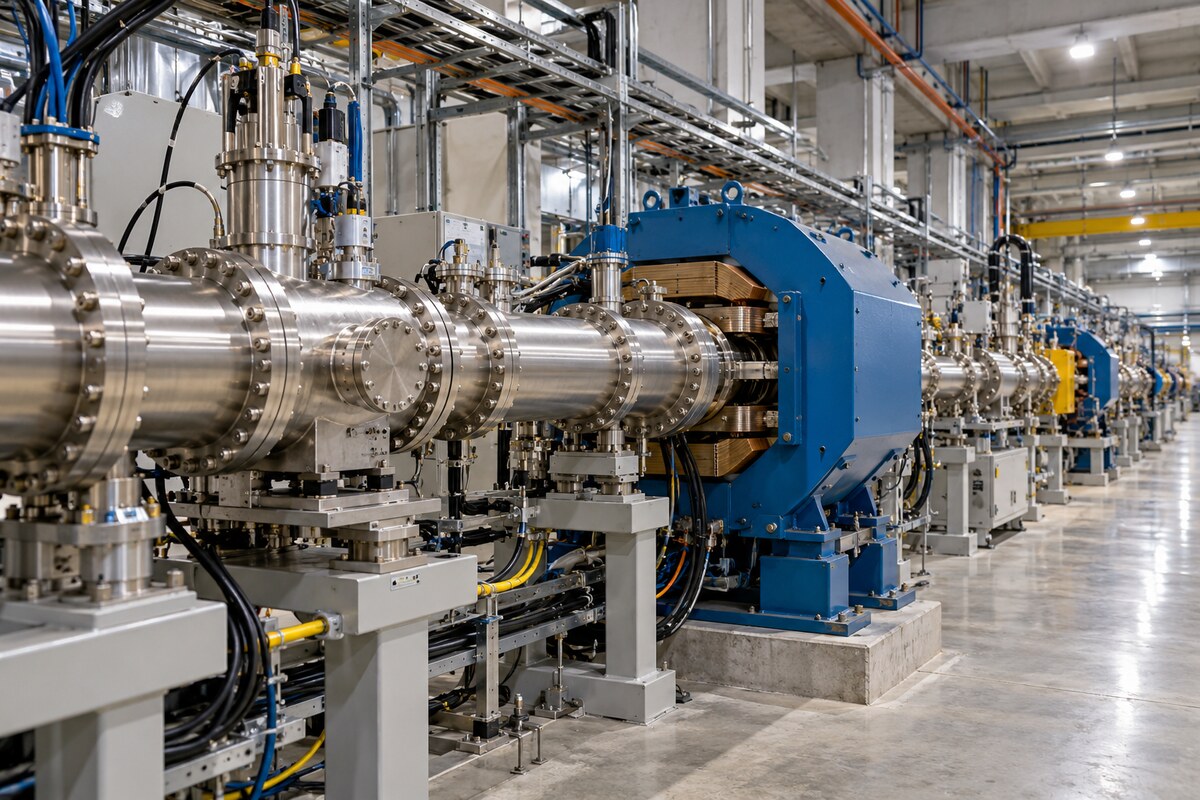
The High Intensity heavy-ion Accelerator Facility, HIAF, completed beam commissioning during testing on Oct 28, 2025, according to the Institute of Modern Physics of the Chinese Academy of Sciences. The facility stands in Huizhou, Guangdong, in China. Its construction began in December 2018.
HIAF contains more than 6,000 large equipment units, nearly five million component parts and over one million metres of pipelines. IMP credited digital-twin technology with reducing installation to eight months, against a typical two to three years. At the October milestone, further beam-performance tests remained on the programme. IMP expected a first scientific experiment before the end of 2025, followed by technical acceptance. The commissioning announcement therefore preceded subsequent experimental results.
From the injector to the storage ring
HIAF's beam chain joins a superconducting ion source, an injector linear accelerator called iLinac, the BRing booster, a fragment separator and the SRing spectrometer ring. Six experimental terminals serve different parts of the complex. The October 2025 accelerator design gives lengths of 114 metres for iLinac, 569 metres for BRing, 192 metres for the HFRS separator and 277 metres for SRing.

The stages have different design energies and magnetic rigidities. For uranium ions with charge state 35+, iLinac's design energy is 17 MeV per nucleon; BRing's is 835 MeV per nucleon. Magnetic rigidity, expressed in tesla-metres, is specified separately for the transport and ring systems:
- BRing: 34 tesla-metres.
- HFRS: 25 tesla-metres.
- SRing: 15 tesla-metres.
The injector's radio-frequency quadrupole operates at 81.25 MHz and raises beam energy from 0.014 to 0.8 MeV per nucleon. These specifications refer to particular stages and ion conditions within the accelerator chain.
A hybrid magnet for ion-source development
IMP's FECR ion-source development combined microwave heating with superconducting magnets. During development of its full-length niobium-tin magnet, the coldmass experienced excessive stress during assembly, broken sextupole-coil leads and an associated insulation risk. A hybrid version retained niobium-tin solenoids and replaced the sextupole coils with niobium-titanium conductors, keeping the magnet structure.

The hybrid configuration provided about 80 per cent of the original niobium-tin magnet's field. Its first beam-commissioning setup used microwaves at 45 and 28 GHz and an operating voltage of 25 kV. Microwave power was five to eight kilowatts at 45 GHz and five to six kilowatts at 28 GHz during those initial beam tests. Oxygen, xenon and bismuth were among the commissioned ions. Typical operating fields included mirror peaks of 3.9 and 2.1 tesla, with a radial field of 2.3 tesla. By the September 2024 presentation, the first FECR version had produced beams, while a fully niobium-tin version remained under development. Joint acceleration tests took place at IMP's separate LEAF platform. The development programme addressed both continuous and pulsed highly charged ion beams needed by IMP's accelerators.
Superconducting cavities at cryogenic temperatures
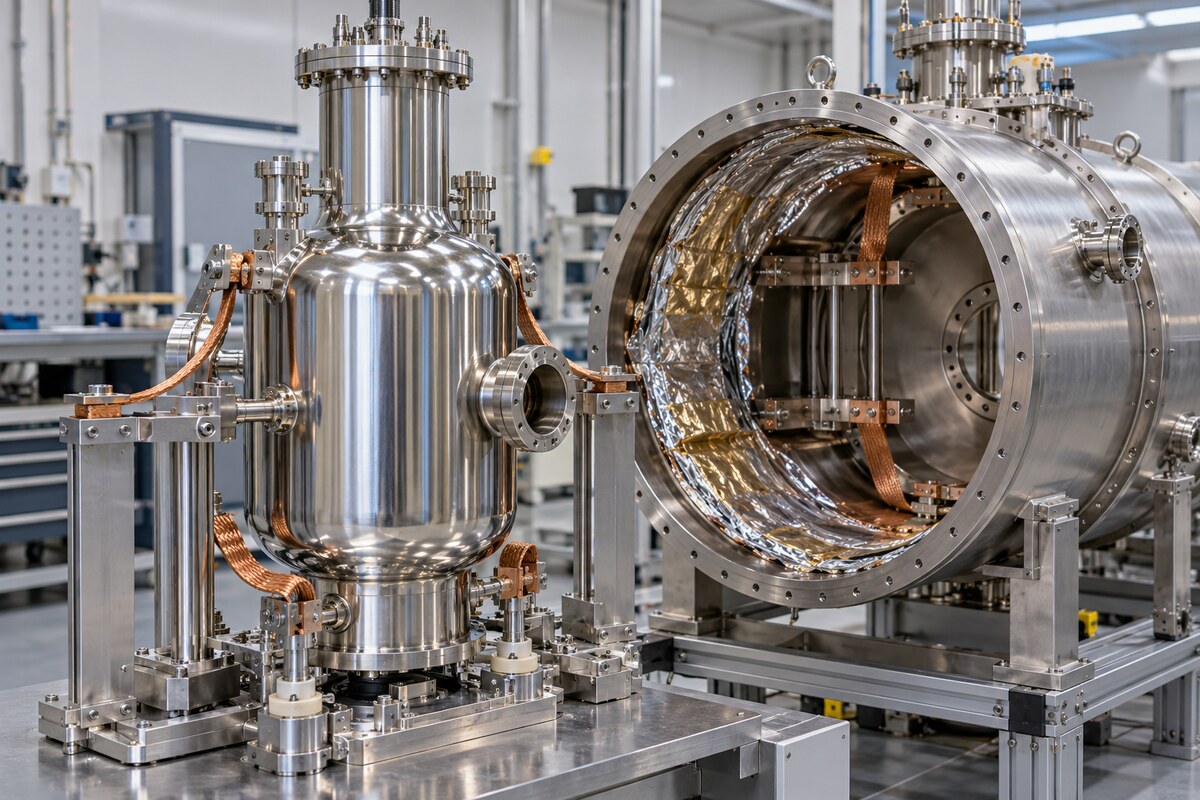
HIAF's superconducting injector uses quarter-wave and half-wave resonators, designated QWR007 and HWR015. The cryomodule configuration includes six QWR007 modules and eleven HWR015 modules. Prototype cavities underwent vertical testing at cryogenic temperatures before the later facility commissioning.
Two quarter-wave prototypes were tested at 2 kelvin and around 4.5 kelvin. At the nominal accelerating gradient of 6 MV/m, the tests found no field emission. Their reported quality factor exceeded 6.6 billion at that gradient, with power loss below 0.74 watt and residual resistance below three nano-ohms. Four half-wave prototypes also underwent testing, including two fitted with helium vessels. The half-wave results included a quality factor above ten billion and power loss below one watt at 6 MV/m. Field emission was absent up to twice the nominal operating gradient. A maximum peak magnetic field of 116 millitesla was reached during testing. The associated cavity equipment included six-kilowatt power couplers with two warm ceramic windows and helium cooling between 5 and 50 kelvin. Prototype measurements refer to the stated test conditions.
RFQ manufacture and cryomodule assembly
The injector's radio-frequency quadrupole was manufactured in nine segments. Five-axis machining produced the components, followed by welding in a hydrogen furnace. Each welded segment underwent a leak test. Manufacture finished at the end of 2023 after approximately two years of work.
Low-power tests measured a field asymmetry below 1.25 per cent. The measured frequency was 81.2845 MHz, with field flatness below one per cent. At that stage, tunnel installation and high-power conditioning were still scheduled activities. The first HWR015 cryomodule prototype was assembled in Huizhou. Its rectangular enclosure used a bottom-loading arrangement, and preassembly tests were completed while the cryogenic infrastructure for horizontal testing was being constructed. The RFQ's four-vane structure incorporated pi-mode rods, tuners and undercuts. Cryomodule low-temperature testing was being prepared at Dongjiang Laboratory, with the first HWR015 unit providing an assembly prototype for the bottom-loading design.
Measuring large-aperture quadrupoles
BRing's magnet inventory includes 48 dipoles, 78 quadrupoles, 30 sextupoles and 80 correction magnets. The quadrupoles come in three families, with 60, six and twelve magnets respectively. Their bore radii are 90, 130 and 90 millimetres; the larger family therefore has a bore diameter of 260 millimetres.

Magnetic measurements combine Hall mapping with rotating coils. A Hall probe mounted on a four-metre carbon-fibre holder measures the field distribution. The support permits adjustment in six degrees of freedom, with an air-guided system and laser tracking used for positioning. Rotating-coil measurements determine field integrals, magnetic centres and harmonic content. The laboratory temperature was maintained at 22 degrees Celsius, within half a degree. Measurement requirements included field-integral reproducibility of 1.5 × 10⁻⁴, harmonic measurements at two parts per million and magnetic-centre positioning at 0.2 millimetre. The batch assessment found that harmonic requirements were met. The measurement programme also investigated mechanical torsion, moving-part vibration, electrical noise and power-supply ripple as sources of error.
Calibrating beam-position monitors
Beam-position monitors provide measurements across BRing, SRing and HFRS. The monitor development programme covered 79 sets, including 40 for BRing and 32 for SRing. Ten specifications accommodate different beam-pipe dimensions, with electrode inner diameters ranging from 180 to 330 millimetres.
The calibration arrangement reproduces the monitor's adjoining pipes. Electric fields near the ends of the electrodes change when the surrounding pipe geometry changes, affecting the relationship between electrode signals and beam position. A calibration using a bare monitor can consequently differ from one performed with its actual connecting pipes. The geometry study found errors reaching nine millimetres under the mismatched arrangement. A laser tracker assists alignment on the calibration platform, whose positioning at the motor's edge was within 0.1 millimetre. Electrical checks examined capacitance, isolation and resonances. The monitors showed no resonance below 300 MHz, while isolation was below −34 decibels at frequencies under 10 MHz. Their electrode capacitance was approximately 50 picofarads. These checks accompanied the position-calibration work for the different monitor sizes.

Processing the electrode signals
Digital electronics process the beam-position signals using a field-programmable gate array. The signal-processing design handles the 162.5 MHz fundamental and its 325 MHz second harmonic. Sampling at 125 MHz translates those inputs to intermediate frequencies of 37.5 and 50 MHz respectively.
The processing chain uses in-phase and quadrature signals together with a Hilbert transform. Laboratory tests evaluated phase and position stability at both input frequencies. At a normal signal level of −45 dBm, the measured phase standard deviation was below 0.1 degree and the position standard deviation below 20 micrometres. Those figures describe the specified laboratory signal conditions. Simulated pulses lasting one and five microseconds were used to examine the algorithm's execution, which took 3.4 microseconds. The converter's rated maximum sampling rate was 130 million samples per second, while the tests used 125 million. The laboratory programme included checks of the electronics' behaviour with short pulses and changes in signal strength. The algorithm timing and the signal-stability measurements refer to different parts of that evaluation.
Keeping data around an interlock
The beam-position interlock electronics retain diagnostic information when a monitored condition changes. Twenty-five state latches cover signals including position, phase, intensity, raw converter saturation and transmission efficiency. An FPGA communicates the latched information to an ARM processor through an AXI-Lite interface.

A circular buffer in block memory stores a total of 8.192 milliseconds of data. When an interlock occurs, the trigger address is retained and acquisition continues for another 4,096 samples. The stored address then allows retrieval of the earlier part of the buffer alongside the subsequent samples. After the data are saved, the interlock flag can be cleared manually. The validation programme included online work at the CAFe linac in Lanzhou and laboratory data-capture tests. State pulses lasting three to ten microseconds were used within the local electronics. The implemented memory arrangement used 40.9 megabits of block RAM. A proposed extension using DDR memory would increase the capture duration to 2.5 seconds; that longer window was a future development.
Distributed machine protection
HIAF's machine-protection design divides the facility into thirteen sections. Two master units and eight slave units form part of a three-layer system of interfaces, slaves and masters. The main arrangement is a tree, while BRing uses links running in both directions around a ring.
Inputs include beam-position, beam-loss and beam-current monitors, together with signals from power supplies, radio-frequency equipment, injection and extraction systems, and slower programmable-logic controls. Personnel-protection signals enter the master level with the highest priority. Interface and slave units use triple-redundant FPGA arrangements; master units use dual redundancy. A prototype chain comprising an interface, a slave and a master measured about 4.6 microseconds between an OK/NOK input and the mitigation output. Its design requirement was 20 microseconds. The 2024 protection-system tests concerned that prototype chain. Integration and commissioning of the wider system remained subsequent work at the time. The architecture combines information from several accelerator subsystems before issuing its mitigation signals.

An electron cooler for SRing
SRing's electron cooler uses a magnetized direct-current electron beam. It serves normal storage-ring and internal-target operation; the isochronous mass-measurement mode has a different operating arrangement. The cooler's design specifies a maximum acceleration voltage of 450 kV, a maximum electron current of two amperes and an effective cooling length of 7.4 metres.
Assembly was completed in May 2025. Primary commissioning reached a few hundred milliamperes at 200 keV. The cooling section's magnetic-field adjustment achieved a homogeneity of 4 × 10⁻⁵. Vacuum measurements reached 1.4 × 10⁻¹¹ millibar in the cooling section. A laser-based compass measured the solenoids' field direction, and the coils were adjusted using those measurements.
Cooling calculations for uranium ions at 800 MeV per nucleon predicted a rapid decrease in emittance and momentum spread during the first ten seconds. Those curves were simulations. Electron-gun commissioning included cathode conditioning and measurements of the gun's perveance. The cooler's development work was published in May 2026.

April 2026: a storage-ring mass measurement
SRing's experimental terminal passed an acceptance review on Apr 8, 2026. Bismuth-209 beams had reached the ring in December 2025, following oxygen-beam commissioning in October. The later terminal milestone applied to the storage-ring experimental system within HIAF.
The mass-measurement work used Schottky signals to monitor circulating ions without destroying them. Researchers measured gold-202, whose lifetime is approximately 28 seconds, and obtained a quoted mass accuracy of 11 keV. IMP compared the precision with earlier measurements at GSI's ESR ring and described an improvement by a factor of two.
Nuclear masses supply information for research on nuclear forces, changes in nuclear structure and the cosmic origin of heavy elements. SRing's construction objectives include mass measurements of nuclei with lifetimes as short as tens of microseconds. The April experiment improved the measured mass accuracy of several nuclei. IMP assessed the result as meeting key SRing design specifications and preparing the experimental terminal for scientific operation.

July 2026: hafnium beyond earlier observations
HIAF entered trial operation on Jul 21, 2026. A further physics result announced on Jul 30 concerned hafnium-153, observed during commissioning. The experiment began with bismuth-209 ions accelerated in BRing and directed onto a graphite target. Projectile fragmentation produced nuclei that were separated and transported through HIRIBL before entering SRing.
Isochronous mass spectrometry supplied the identification method in the storage ring. Ten hafnium-153 ions were observed. Researchers interpreted the result as evidence that the isotope is bound or weakly bound, extending experimental information in that region of the nuclear chart. The small number refers to individually observed ions in the experiment.
The July hafnium result appeared as a short communication in Science Bulletin. IMP's State Key Laboratory of Heavy Ion Science and Technology led the research with partners including the University of the Chinese Academy of Sciences, GSI, the University of Cologne, East China University of Technology and the Advanced Energy Science and Technology Guangdong Laboratory. Hafnium-153 lies in the neutron-deficient heavy-nucleus region, where experimental observations supply tests of nuclear-mass models.

















Leave a comment