
A clearer black-hole ringdown
LIGO’s Hanford and Livingston detectors recorded unusually clear gravitational waves, GW250114, in January 2025. Two black holes, each roughly thirty times the Sun’s mass, merged into a larger object whose fading vibrations included a fundamental mode and a faster-decaying first overtone. The signal stood about eighty times above background noise, compared with a signal-to-noise ratio of twenty-six for LIGO’s first detection in 2015. The September 10 study appeared in Physical Review Letters. Caltech physicist Katerina Chatziioannou participated in the research.
The measured ringing agreed with Roy Kerr’s 1963 solution for a spinning black hole. The remnant’s horizon area also exceeded the combined areas of its predecessors, consistent with Stephen Hawking’s area theorem, developed in the 1970s. Earlier gravitational-wave observations had tested that theorem; the new signal supported a more precise check. A decade of detector improvements preceded this measurement, which connected controlled instruments on Earth with the dynamics of a distant merger. The ringdown tests used this clearer signal.
Preparing an observing network
The fourth observing run, O4, began on May 24, 2023. LIGO’s twin observatories resumed operations after an engineering period that had already produced candidate events. The instruments in the United States belong to the wider LIGO–Virgo–KAGRA collaboration. At launch, the team announced an approximately thirty percent sensitivity improvement and anticipated detecting a merger every two or three days. Those figures described the upgraded run’s expectations. The initial schedule allowed twenty months, including commissioning breaks, while different observatories were due to join at different stages.

Virgo continued commissioning before participating, and KAGRA initially planned a month of observations before further upgrades. Albert Lazzarini, LIGO Laboratory’s deputy director, described the engineering candidates as predominantly binary black holes, with a possible neutron-star system. Public alerts would distribute candidate information to astronomers. Earlier cooperation had connected the 2017 neutron-star merger with a kilonova observed by telescopes. Caltech and MIT operate LIGO with National Science Foundation funding; the wider collaboration brings instrument development and observational research together across many institutions. These organizational arrangements support the shared observing programme.
Controlling quantum uncertainty
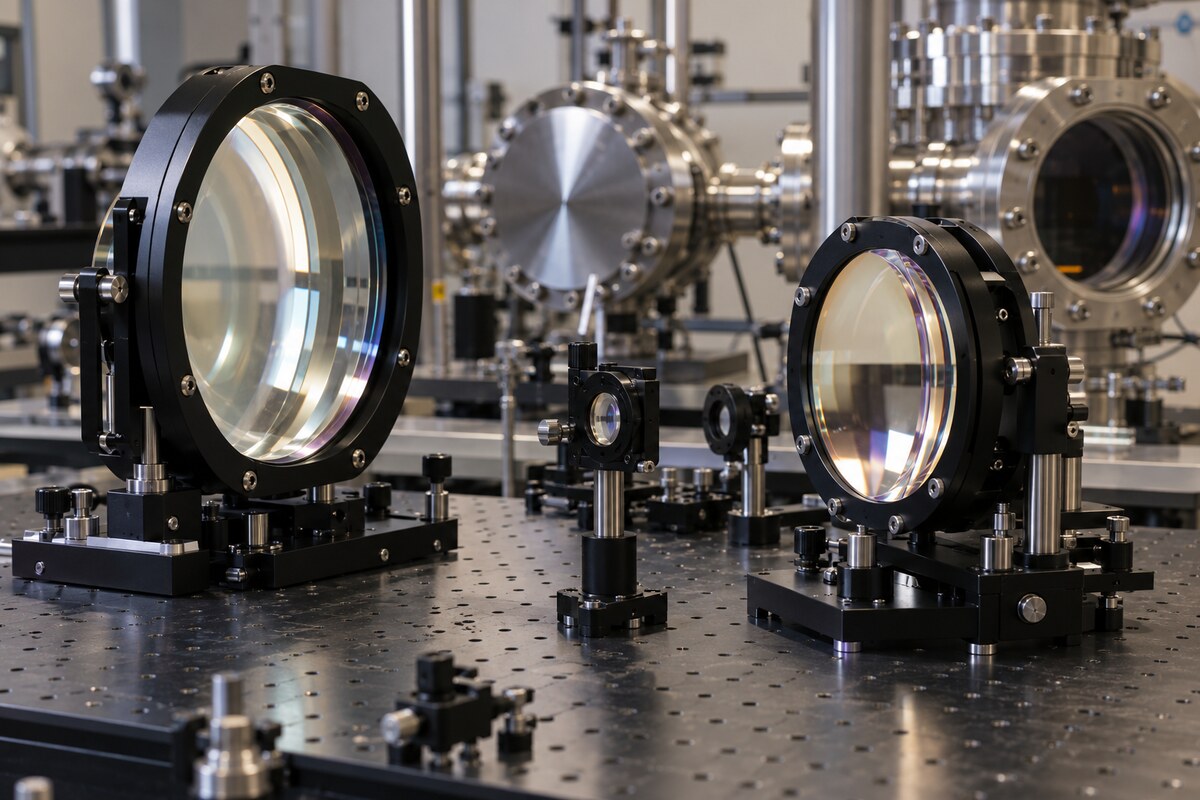
Each LIGO instrument sends laser beams along two perpendicular, four-kilometre arms. Returning light carries information about changes in their relative lengths. Quantum fluctuations limit the precision of that measurement. Earlier squeezing, used from 2019, improved high-frequency sensitivity while introducing a disadvantage at lower frequencies. Greater uncertainty in light’s amplitude can disturb the suspended mirrors through radiation pressure. Simply increasing laser power also introduces stronger photon forces. The challenge therefore involves the behaviour of both the light and the objects reflecting it, rather than laser brightness alone.
Frequency-dependent squeezing changes that trade-off across the observing band. A separate three-hundred-metre filter cavity at each site controls the relative phases needed to redistribute quantum uncertainty differently at different frequencies. The technology was operating when LIGO resumed observations in May 2023. Lisa Barsotti oversaw its development; Lee McCuller and colleagues helped lead the study. The team’s October 2023 forecast anticipated about sixty percent more merger detections from the improved reach. That was an expected gain, rather than a count of subsequently confirmed events. Frequency-dependent squeezing addressed broadband sensitivity.

Mirror control and its noise
LIGO’s forty-kilogram suspended mirrors respond to disturbances including slow seismic motion driven by ocean waves. Feedback systems sense unwanted motion and counteract it, but the controls can introduce their own higher-frequency noise. A project involving Caltech, Gran Sasso Science Institute and Google DeepMind investigated this control problem with reinforcement learning. The method, Deep Loop Shaping, trained on simulations to reduce disturbance while maintaining stability. The relevant control noise occupies the ten-to-thirty-hertz region, where heavier black-hole mergers and earlier portions of inspiral signals can contribute information.
In September 2025, the researchers announced a proof-of-concept demonstration that reduced particular mirror motions thirty to one hundred times more than traditional methods alone. The test lasted only an hour. Longer trials and use on additional systems remained future work. Christopher Wipf described the interaction between external disturbance and noise introduced by the controller; Rana Adhikari emphasized the potential for better measurements. The demonstrated reduction concerned a specific control problem. It was not an equivalent improvement in every part of the detector’s sensitivity, nor an explanation for the January signal recorded before this announcement.
Maintaining the observing instruments
Instrument operation also depends on maintenance that requires observation to stop. In February 2025, the collaboration announced an April-to-June break and an extension of O4. A faulty beam-tube gate valve at Livingston needed repair before hurricane season. Earlier interruptions had included a Livingston shutter failure, damage to Hanford’s output Faraday equipment and laser glitches. The February schedule proposed ending O4 on October 7. That was an interim plan, subsequently superseded as the observing programme continued. Maintenance dates and exposure totals therefore belong to particular versions of the schedule.

At that stage, LIGO’s duty cycle was around sixty-five to eighty percent, while Virgo’s was about seventy percent. Duty cycle measured the share of time spent observing in suitable operating conditions. In February, the instruments had these ranges and operating targets:
- LIGO’s binary-neutron-star range was about 160–170 megaparsecs.
- Virgo’s corresponding range was about 50–55 megaparsecs.
- KAGRA was still pursuing noise reduction, mirror cooling and a planned increase in laser input power.
Recovering vibration isolation
KAGRA’s contribution depended on recovering hardware damaged by the Noto Peninsula earthquake on January 1, 2024. The earthquake severely affected many vibration-isolation systems supporting its mirrors. Recovery work finished by autumn 2024, after which sensitivity improvements continued. KAGRA resumed O4 observations on June 12, 2025. During the initial phase of O4, it had operated from May 25 to June 21, 2023, using local dates. These separate operating periods reflect commissioning and recovery within the same international observing run, rather than uninterrupted participation throughout its duration.
The project in Japan marked the end of O4 at one in the morning on November 19, 2025, corresponding to November 18 in UTC. At run end, the collaboration estimated approximately three hundred significant signals and had published results on the first 128 events. Those were preliminary run-end and published-sample descriptions, respectively. After observing, the network entered maintenance and upgrades. KAGRA thanked contributors for encouragement and donations during recovery.

Checking calibration with cosmic signals
A separate development, announced in May 2026, used strong astronomical signals to examine detector calibration. The events GW240925 and GW250207 arrived on September 25, 2024, and February 7, 2025. Hanford was operating below its usual standard during both detections. For the first event, a temporary calibration error was monitored and later corrected. For the second, the instrument was coming online without all its monitoring systems ready. Researchers compared Hanford’s measurements with signals from Livingston and Virgo, alongside predictions based on general relativity.
The first case supplied a known calibration problem against which to check the method. In the second, reliable on-site calibration measurements were unavailable, making the astronomical comparison particularly useful. Correcting the response improved estimates of source properties and sky position. The analysis depended on sufficiently strong signals, other instruments and theoretical waveform predictions. It therefore combined physical models with network observations rather than providing a model-free calibration. Christopher Berry and colleagues at Glasgow participated in the work. Astrophysical calibration added a way to recover information from imperfectly calibrated measurements.

Computing the waveforms
Numerical simulations supply another part of the measurement process. The Simulating eXtreme Spacetimes collaboration, SXS, computes gravitational waveforms from black-hole mergers by solving Einstein’s equations. By October 2025, its third catalogue contained 3,756 simulations, nearly twice the size of the 2019 collection. Researchers use initial conditions to calculate how a binary evolves and examine convergence as numerical resolution increases. The simulations and accompanying code are publicly available, allowing other researchers to compare calculated waveforms with observations or request calculations for additional parameters.
The expanded collection included gravitational-wave memory, a predicted lasting change in spacetime after a wave has passed. Its inclusion in a numerical model did not constitute a new observational detection of memory. Keefe Mitman described the relationship between the numerical equations, evolving initial data and convergence. Saul Teukolsky explained that waveform models used in searches are calibrated against accurate simulations. These calculations support comparisons between observed mergers and general relativity. The catalogue concerns modeled systems, with different masses and other starting properties, rather than thousands of independently observed mergers. Numerical and observational catalogues consequently contain different kinds of records.
Releasing strain and instrument records
The Gravitational Wave Open Science Center released O4a data on August 26, 2025. That segment covered May 24, 2023, at 15:00 UTC through January 16, 2024, at 16:00 UTC. Its strain measurements came from Hanford and Livingston. Additional earlier segments were included for analyses involving supernova SN2023ixf and event GW230518_125908. The release offered original and downsampled streams, together with alternative strain versions. Its documentation identified the final channels and linked separate information about cleaning, data quality and detector performance, allowing users to distinguish the available products.

Auxiliary records monitor instrument subsystems and the surrounding environment. Selected channels support data cleaning and quality flags. The release also documents deliberate hardware injections: simulated astrophysical signals introduced for testing and calibration. Instrumental spectral lines have their own explanations and catalogue. These features accompany the measured strain rather than representing extra astronomical sources. Users can obtain time segments describing public availability and consult archived sensitivity plots. The published materials thus include measurements, operating context and testing information. Checking those categories is part of choosing which recorded intervals and channels to use for a particular analysis.
A later three-detector release
O4b data became public in May 2026, covering April 10, 2024, at 15:00 UTC through January 28, 2025, at 17:00 UTC. This interval included Virgo alongside both LIGO instruments. Additional data starting on April 6 supported searches associated with supernova SN2024ggi. The release provided separate final channel names for Hanford, Livingston and Virgo, and distinguished some pre-run segments from the main data. Multiple strain versions remained available for different cleaning methods. Its documentation also linked the associated catalogue, detector-status information and astrophysical results for the observing interval.
The sampling conventions require attention when using either release. Original streams sampled at 16,384 hertz were also repackaged at 4,096 hertz. Advanced LIGO and Virgo strain is not calibrated as valid below ten hertz or above five kilohertz; the lower-rate data are not valid above about 1,700 hertz. Most astrophysical searches omit frequencies below twenty hertz because noise is too high. These are data-use limits. A file’s sampling rate, an instrument’s calibrated band and the frequency interval chosen for a search are separately specified quantities in the public documentation.

From measurements to a catalogue
The GWTC-4.0 results, presented in a March 2026 announcement, added 128 new gravitational-wave candidates to a previous catalogue containing ninety events. The new sample came from part of the fourth observing run. It included black-hole pairs with unusual masses or spins and two black-hole–neutron-star mergers. The catalogue records signals judged likely to have astrophysical origins and estimates the properties of their sources. It is a different product from a continuous strain-data release or a library of simulated binaries. Each supports a different stage of research using the instruments.
Lucy Thomas helped lead part of the catalogue analysis. Daniel Williams described the expanding coverage of source parameters, including more massive and more rapidly spinning systems. David Reitze connected the larger sample with research on stellar evolution and black-hole formation. Salvatore Vitale discussed possible differences in spin between populations merging at different cosmic times; those interpretations remain research conclusions with their own qualifications. Strong individual signals also supported tests of general relativity. The growing sample combines population studies with detailed event measurements, while retaining the distinction between an estimated astronomical property and a directly recorded instrumental time series.
Building another baseline
LIGO-India broke ground on April 23, 2026, at Aundha in Maharashtra’s Hingoli district. The planned observatory in India occupies a 174-acre site selected for low seismic noise. Its design includes two four-kilometre arms and an Advanced LIGO interferometer. Caltech and LIGO Laboratory are supplying key components, designs, training and support. Indian institutions are responsible for site infrastructure, substantial instrument hardware, installation, commissioning and long-term operation. The groundbreaking was a construction milestone; the announced target for first observations was 2030, rather than an immediate start of scientific measurements.
The extra observatory would add a long baseline and another orientation to the network. Mansi Kasliwal described the expected improvement in triangulating neutron-star mergers, which could help telescopes find their electromagnetic counterparts. Rana Adhikari emphasized newer technology and the training of experimentalists, including undergraduate research exchanges. Caltech’s undergraduate research programme has brought students into hands-on work with LIGO instrumentation for more than a decade. The project expects contributions from more than sixty Indian institutions over its lifetime. Those plans encompass scientists, engineers and students, alongside the observatory’s construction and future operations.













Leave a comment